
FAMU President Visits BAERS, Emphasizes Land-Grant Mission in Central Florida
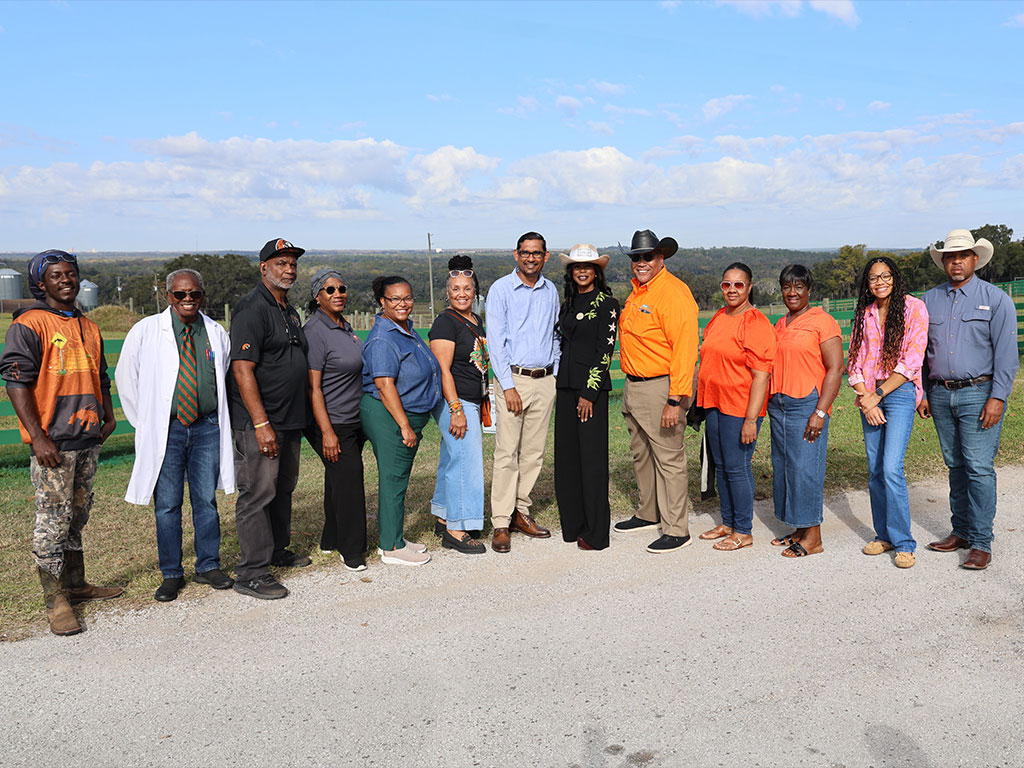
Brooksville, Fla. – Florida A&M University (FAMU) and the College of Agriculture and Food Sciences (CAFS) displayed their growing impact during President Marva B. Johnson’s visit to the university’s Brooksville Agricultural & Environmental Research Station (BAERS). Strategically positioned in the heart of Central Florida, BAERS stands at a pivotal crossroads where agricultural research, environmental stewardship, and urban expansion converge, making it a vital asset to Florida A&M University’s land-grant mission.
FAMU is one of only two land-grant universities in Florida, a responsibility established under the Second Morrill Act of 1890. As an 1890 land-grant institution, the university is charged with providing practical agricultural and scientific education, conducting research that addresses statewide challenges and delivering extension services to farmers, families and underserved communities.
President Johnson emphasized the importance of this mission, noting that FAMU’s land-grant identity remains central to how the institution serves the people of Florida.
“I am committed to ensuring that all FAMU campuses are aligned and mission-focused so that we operate as one FAMU to uplift the communities we serve,” Johnson said. “The BAERS campus is one of our greatest assets to expand our research footprint as we enhance FAMU’s presence in Central Florida’s agriculture–urban corridor.”
During the tour, Johnson and university administrators visited several key operations across the 3,800-acre BAERS property, including agricultural research plots, rangeland conservation areas and livestock and forage units. They met with faculty and staff who outlined ongoing work in emerging crop development, soil improvement, pasture management and wildlife habitat restoration. Johnson also visited the Rattler Solar Farm, a nearly 700-acre solar installation that is approximately 90 percent complete. A ribbon-cutting ceremony is planned for February 2026.
G. Dale Wesson, Ph.D., dean and director of Land-Grant Programs for CAFS, recently appointed Ramdeo Seepaul, Ph.D., as the new BAERS executive director, bringing leadership that is shaping the station’s strategic expansion. Today, BAERS researchers are advancing work in resource-efficient agriculture, soil health, livestock systems, ecosystem restoration, specialty crops and workforce development. The station also partners with local producers, state agencies and industry to strengthen environmental resilience and support rural economic opportunity.
“As we continue to elevate our research enterprise, BAERS plays a pivotal role in expanding CAFS’ capacity to address Florida’s most pressing agricultural and environmental challenges,” Wesson said. “Our work here strengthens the university’s land-grant mission and creates new opportunities for innovation, collaboration and student success.”
“FAMU’s land-grant mission is alive and thriving at BAERS,” Seepaul said. “We remain focused on delivering research and outreach that directly support Florida’s agricultural communities and natural resources.”
Looking ahead, BAERS aims to develop as a regional innovation hub that connects agriculture, environmental science, engineering, business and community engagement. Future initiatives include expanding research in water quality, carbon sequestration, biodiversity monitoring, economic development, youth STEM education and community wellness.
“With the right investments and partnerships, BAERS can serve as a national model for resource-efficient, community-driven research and education,” Seepaul said.
The Brooksville site has deep historical roots. In 1932, Col. Raymond Robins donated land for the establishment of an agricultural research facility spanning nearly 3,800 acres. From 1929 to 2012, the U.S. Department of Agriculture’s Agricultural Research Service operated the Subtropical Agricultural Research Station (STARS), known for its cattle and forage research. On Oct. 20, 2015, the USDA transferred the 3,800-acre site to FAMU — one of the largest federal land transfers ever made to an 1890 land-grant institution. Since then, FAMU has expanded BAERS to strengthen land-grant research, education and extension services throughout Central Florida.
Media Contact
Rachel James-Terry
Senior Director of Strategic Communications
rachel.jamesterry@famu.edu