
The Rackley’s Road: How a Civil Engineering Grad Found His Way Back to His Family’s Blueprint
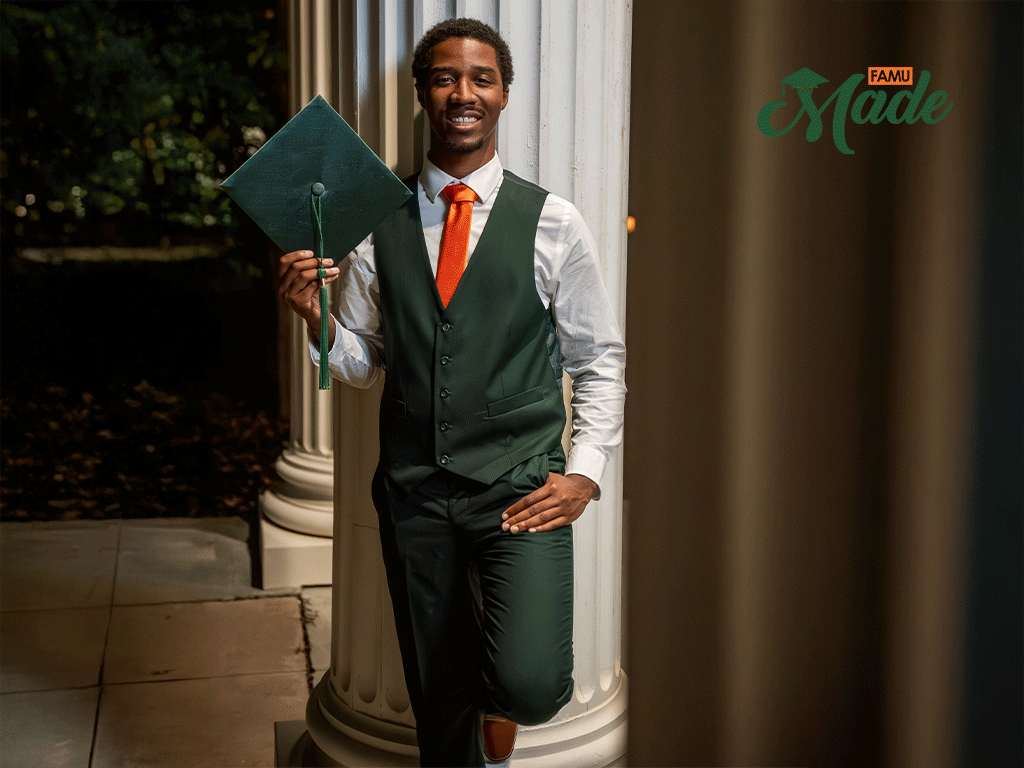
There’s a road in Tallahassee near Jake Gaither Golf Course. It’s a road that carries both a name and a legacy long before Florida A&M University’s newest high-achieving scholar ever stepped on campus. Rackley Drive, named after Charles Rackley’s great-grandfather, Lonnie Rackley Sr., is a salute to a Black builder whose hands constructed homes and neighborhoods during a time when Black entrepreneurship was not the norm.
Now, his great-grandson is graduating from the FAMU-FSU College of Engineering with the highest GPA in his class, a 3.9.
Finding a New but Familiar Path
Charles, a civil engineering major from Wesley Chapel, didn’t plan to follow family lineage. In fact, he openly resisted it.
“I really wasn't strongly considering FAMU at first because I did not want to go and be a legacy,” he said. “My parents went there. My grandparents went there. At first, I wanted to do something different.”
But legacies have a way of spinning the block. For Charles, the engineering spark came unexpectedly in high school after watching the growth of his once-quiet suburb outpace the development. Traffic backups and deteriorating roads were becoming the norm.
“Maybe I was being a little cocky,” he laughed, “But I felt like I could have planned the traffic infrastructure a little bit better.”
That confidence wasn’t arrogance. It was more like his family’s history beckoning him.
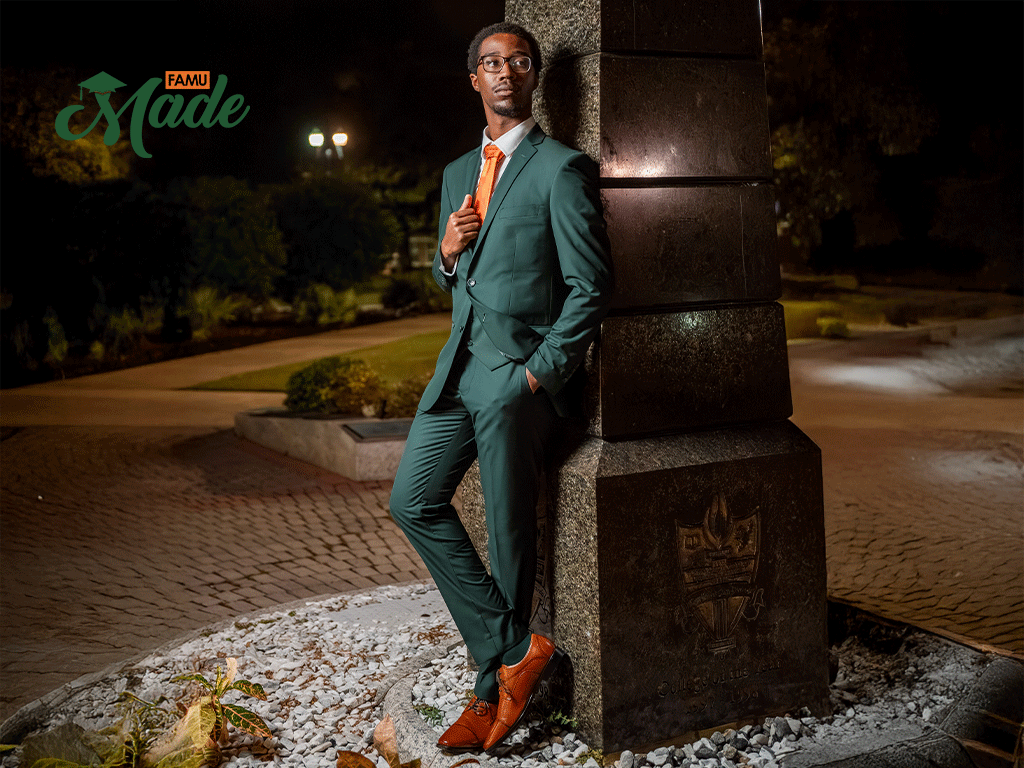 Charles Rackley now understands the power of his family's history and how it winds
into his road. (Photo special to FAMU)
Charles Rackley now understands the power of his family's history and how it winds
into his road. (Photo special to FAMU)
Orientation, Community, and the Hill
Charles’ mother, Qiana Rackley, says they never pressured him to attend their alma mater.
“We always wanted him to make his own choice about college,” she said. “Even though we raised him with FAMU values.”
So, when Charles chose the Rattler life, they were somewhat shocked and thrilled. She also understood what he was stepping into:
“FAMU, like any HBCU, offers something rare: a true safe space where you're free from the usual judgments about skin color, hair, or style that exist in the ‘real world.’ It’s a once-in-a-lifetime experience.”
Charles felt that immediately. Although he had attended plenty of FAMU football games,
homecomings and the like, orientation was his first time experiencing the campus without
family. And that’s when he knew he was home.
“I was a little bit nervous, of course to be around all Black people at first. Growing
up, I only had like two other Black people in my classes. But here I quickly found
my people,” he recalled. “Orientation was just a good time. We walked around campus.
We walked to the gas station. We walked all the way to CollegeTown on the first night.”
And, as one may expect, his new home eventually led him back to his roots.
A Top Scholar
Charles didn’t know he would graduate with the highest GPA until a classmate texted him from an event he inadvertently missed.
“They were like, ‘Charles… you got an award. Go see Dr. Spainhour she has it,’” he explained. “I really wasn’t expecting it honestly.”
Lisa Spainhour, Ph.D., P.E., professor and chair of the Civil and Environmental Engineering Department in the FAMU-FSU College of Engineering, said the recognition is well deserved.
“Academically, Charles is among the top students in the college. But where he truly shines is outside the classroom, where he has done everything from undergraduate research to helping with outreach events,” Spainhour said. “I called on him many times to showcase his sustainable demolition work to department visitors.”
Although Charles tried to minimize his accomplishments, his mother wasn’t having that.
“I’m beyond proud of him. Watching his hard work pay off in such an extraordinary way fills me with joy. He’s always been humble, and I knew he might try to downplay this achievement,” she said. “But earning the highest GPA is no small feat. I wanted him to truly embrace this moment because it represents years of effort, sacrifice, and perseverance.”
And in her words, “This is something worth celebrating.”
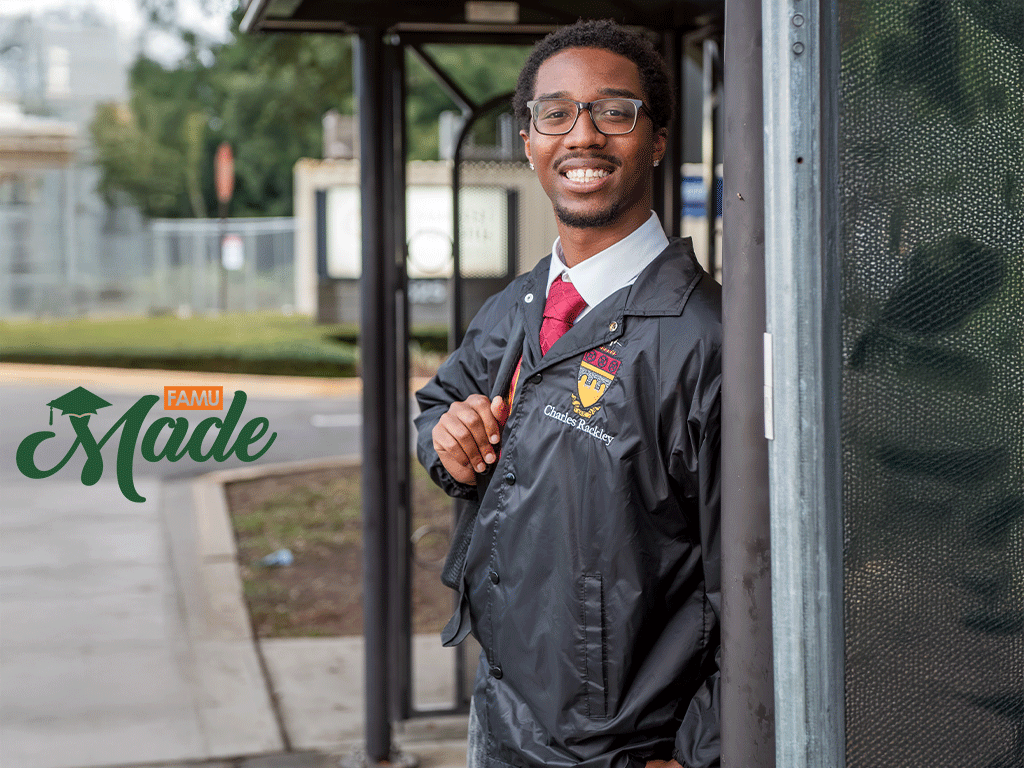 After graduation, Charles Rackley will pursue his master's in geotechnical engineering.
(Photo special to FAMU)
After graduation, Charles Rackley will pursue his master's in geotechnical engineering.
(Photo special to FAMU)
Research and Discovery
Equally worth celebrating are the opportunities Charles explored during his undergraduate years. First working with a Ph.D. student in the FAMU-FSU College of Engineering on reducing carbon emissions from construction and demolition sites. Later, he ran simulations at Sandia National Laboratories in Albuquerque to identify metals that could withstand the heat of a fusion reactor.
For those unfamiliar with the field, this work was significant and played a key role in helping him define the career path he wanted to pursue.
“It was a good time, but I don’t think it was for me,” he said.
What ultimately felt right was something unexpectedly quirky: designing salmon passageways during his Colorado internship with Kiewit, one of North America’s largest and most respected engineering and construction organizations.
Charles explained that salmon, the primary food source for a Native tribe in Washington State, had become increasingly scarce due to underground construction. Washington State needed safer routes for salmon migration after old culverts blocked natural movement. Kiewit was contracted to find the solution.
Charles helped design the structures that would open those pathways.
“It was amazing. I did a lot of different things, and it was so good for me to experience all of that. The work had me really excited. This is the work I want to do with my degree,” he said.
This was the work that would connect his present to his past and then back to the future.
The Legacy Continues
As a child visiting Rackley Drive, Charles had no interest in why a road bore his family’s last name. But years later, as a young man, his father, Charles Rackley Jr., took him back there and the picture came into focus.
His great-grandfather, Lonnie Rackley Sr., a Black man running a construction company perhaps decades before integration, built every house on Rackley Drive and many others around Tallahassee.
Charles didn’t know any of this when he chose civil engineering. But when he found out?
“It felt like confirmation,” he said. “Like this is what I’m supposed to be doing.”
His father and mother see the connection, too.
“His great-grandfather’s knowledge of building and creating runs deep in our family. It’s a skillset passed down through generations,” Charles Rackley Jr. said.
Charles isn’t leaving campus just yet. He’s staying for a one-year master’s in geotechnical engineering, the specialty that studies the soils and foundations everything else depends on.
“We are thrilled that Charles will be returning to our program this spring as a master’s student. I can’t wait to see what impact he will make in grad school and beyond,” Spainhour said.
And his dream employer, at least for now, is Kiewit. He wants to return and keep doing the kind of work that moves communities, literally and figuratively.
His father sees something bigger unfolding:
“Whatever direction he chooses, he will build on our family name in his own way. He’s charting a path that’s uniquely his,” he said.
A road once built by his great-grandfather still stands in Tallahassee.
A new road is now being built by Charles.
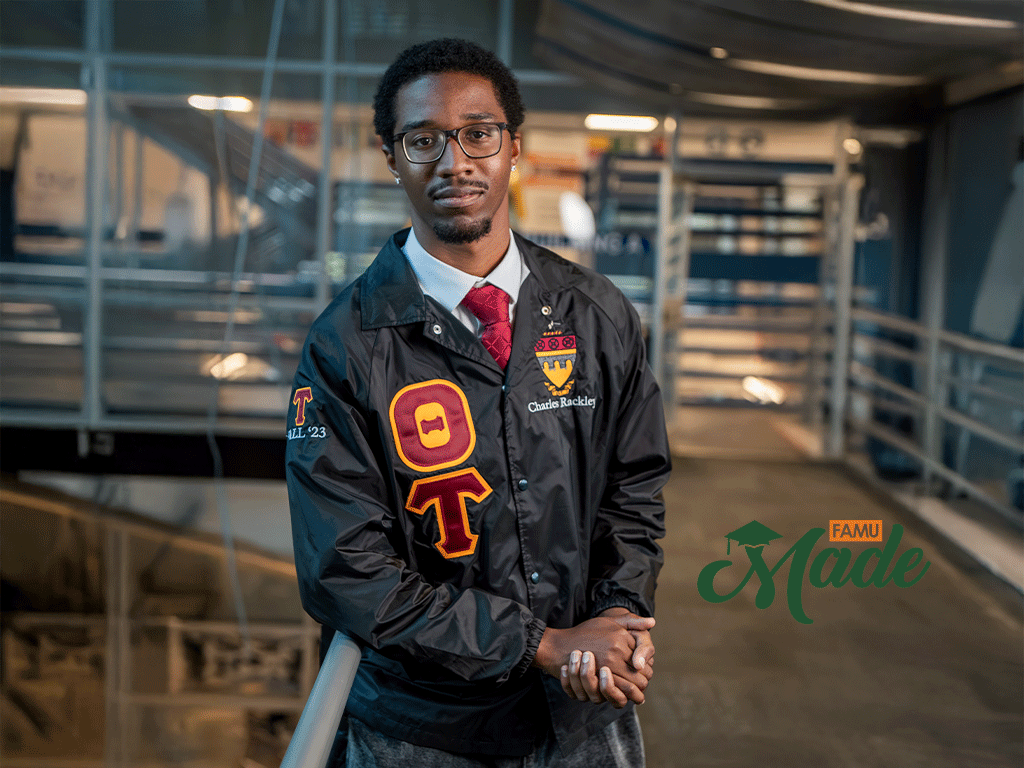 Charles Rackley is building a strong foundation to make sure his future is structurally
sound. (Photo special to JSU)
Charles Rackley is building a strong foundation to make sure his future is structurally
sound. (Photo special to JSU)
Media Contact:
Rachel James-Terry
Senior Director of Strategic Communcations
rachel.jamesterry@famu.edu