
Colder Than Outer Space, FAMU’s New Refrigerators Open the Door to Quantum Discovery
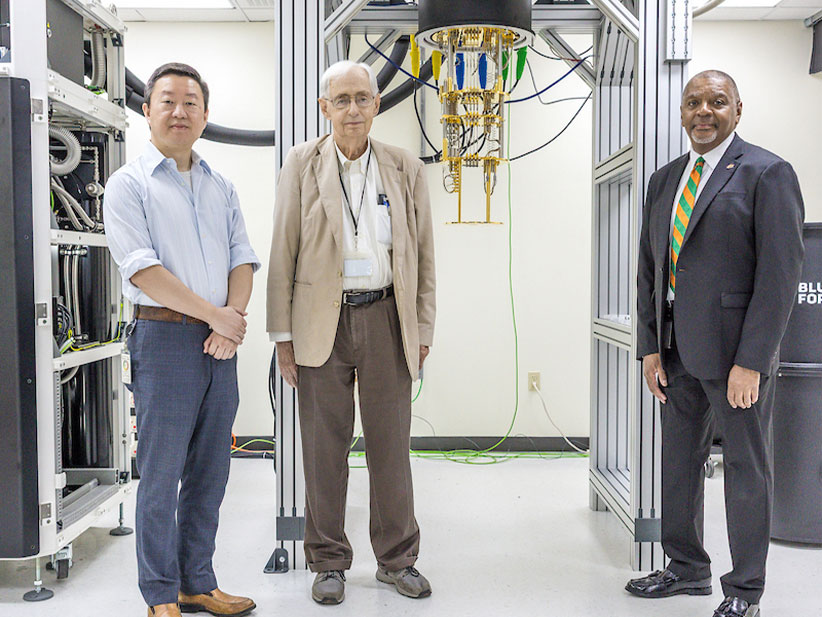
TALLAHASSEE, Fla. — Inside a newly renovated laboratory at Florida A&M University sits a machine capable of creating an environment colder than outer space. It may sound like science fiction, but for FAMU researchers, it is the beginning of something very real, and potentially transformative.
The machine is a dilution refrigerator, one of two purchased through a pair of five-year National Science Foundation grants totaling $10 million. It is not a refrigerator in the familiar sense. There are no shelves or food inside. Its job is to remove nearly every trace of heat and vibration so researchers can study qubits, the extraordinarily sensitive building blocks of quantum computers.
Together, the refrigerators and the quantum research center FAMU established two years ago place the University in a rapidly developing field that could change how scientists’ approach some of society’s most complicated problems, from designing medicines and protecting health data to forecasting weather and producing fertilizer with less energy and pollution.
They also give FAMU students something equally valuable: the opportunity to learn on sophisticated equipment at the leading edge of science without leaving Tallahassee.
“I want to be here for the breakthrough,” said Charles Weatherford, Ph.D., physics professor and director of the FAMU Center for Plasma Science and Technology, where the Quantum Lab is located. “I want to be here when it happens.”
What happens inside an ultra-cold lab
To understand the excitement, it helps to begin with the computers most people use every day. Traditional computers process information through bits, each represented as either a zero or a one. Quantum computers use qubits, which draw on the unusual rules of quantum physics to represent and process information in more complex ways.
That does not mean quantum computers will replace laptops or make every calculation faster. Their promise lies in certain problems with so many possible variables that even today’s conventional systems can struggle to solve them. A quantum computer could examine vast numbers of possibilities in a fraction of the time.
“It can try millions of methods very quickly,” Weatherford said. “That’s what we’re looking for.”
There is a catch: Qubits are fragile. Ordinary heat, vibration and other environmental interference can disrupt their quantum state and introduce errors. The dilution refrigerator creates the quiet, ultra-cold setting needed to control them.
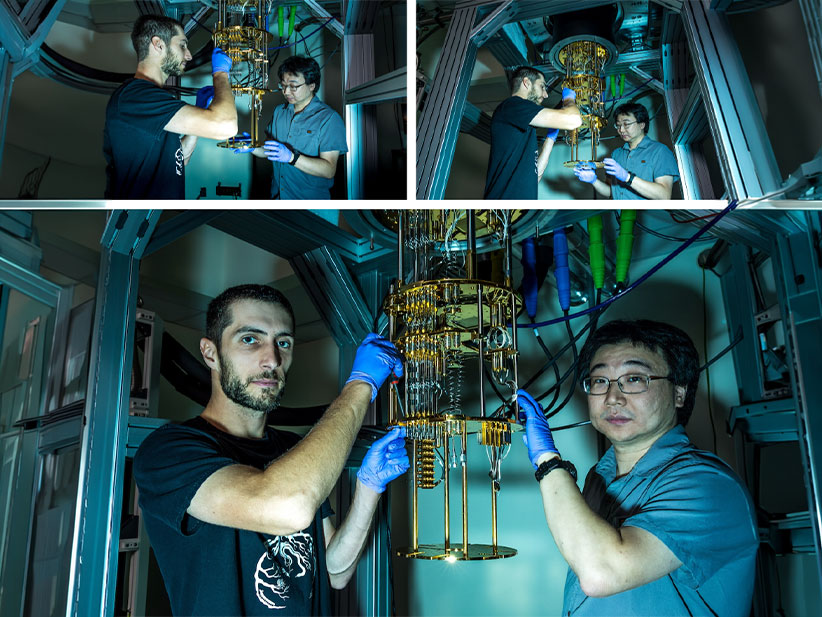 FAMU researchers are hoping to make significant advancements in the frontier of quantum
science. (Photo by Jeff Adams/FAMU)
FAMU researchers are hoping to make significant advancements in the frontier of quantum
science. (Photo by Jeff Adams/FAMU)
“The refrigerator is required to achieve the operating environment for the qubits,” said Wei Guo, Ph.D., a professor of mechanical and aerospace engineering at the FAMU-FSU College of Engineering. “We have to get rid of thermal noise so we can manipulate the quantum state and harness its properties for computing.”
Guo said the first refrigerator has been installed and passed its performance tests. His team plans to begin with a six-qubit chip fabricated through the MIT Quantum Foundry. Researchers will use microwaves to control the qubits and test entanglement, a quantum connection between particles that is essential to how quantum systems process information.
Before researchers can scale a technology, they must first prove they can control it reliably. Each experiment will provide information that can help them build more stable qubits.
“This research is all about developing better qubits,” Guo said. “If we can build a large-scale quantum computer, then we can solve complicated problems that even large clusters of classical computers cannot solve.”
From cleaner fertilizer to stronger data protection
The science is highly technical, but its potential impact is not difficult to imagine.
At FAMU, researchers are studying whether advanced computing can help protect clinical health information by comparing conventional and quantum methods of generating the random numbers used in cybersecurity. Weatherford is also exploring a cleaner way to produce ammonia, an essential ingredient in fertilizer.
Much of the world’s ammonia is made through the Haber-Bosch process, which requires
significant energy and produces substantial carbon emissions. Weatherford and his
collaborators are studying catalysts that could support a cleaner process using less
expensive materials. The chemical interactions are complicated, however, and finding
the right combination may require testing an enormous number of possibilities, precisely
the kind of challenge advanced computing may help researchers untangle.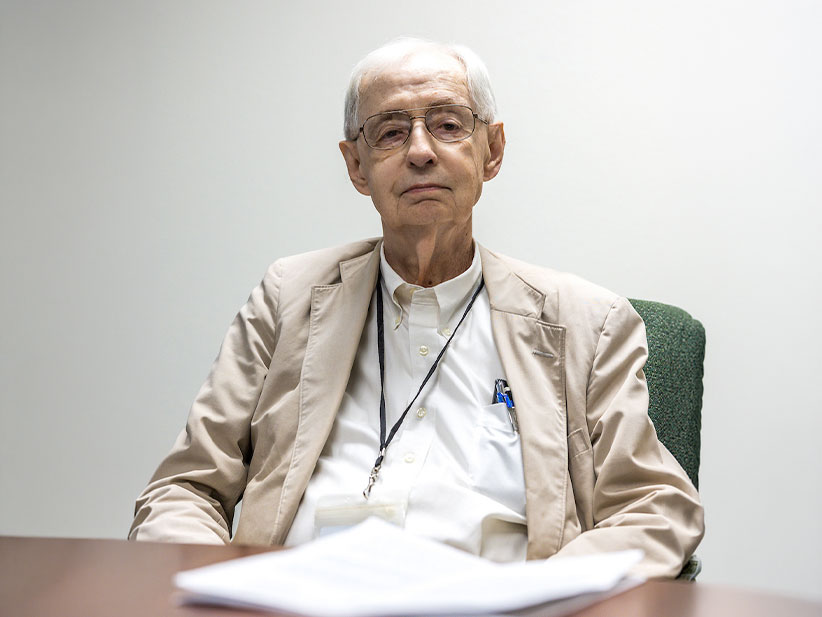 FAMU Physics Professor Charles Weatherford is looking forward to witnessing the scientific
breakthroughs that the dilution refrigerators will make possible. (Photo by Jeff Adams/FAMU)
FAMU Physics Professor Charles Weatherford is looking forward to witnessing the scientific
breakthroughs that the dilution refrigerators will make possible. (Photo by Jeff Adams/FAMU)
Guo sees possibilities in drug development, weather forecasting and materials science. Researchers could use advanced computing to model how molecules interact, potentially narrowing the search for compounds that perform a specific medical function. They could also explore materials that are stronger, more efficient or capable of carrying electricity with far less energy loss.
One of the field’s major goals is developing superconducting materials that function closer to room temperature. Most superconductors must remain extremely cold. If scientists can design materials that offer similar performance under everyday conditions, the discovery could support more efficient power systems and technologies that do not yet exist.
The questions are difficult, and the outcomes are not guaranteed. That uncertainty is part of what keeps Weatherford engaged. “We could do something really important here in this lab,” he said.
Building the infrastructure for R1
A $10 million research investment can purchase impressive equipment, but the equipment still needs the right home. FAMU’s Office of Title III provided approximately $500,000 to renovate and prepare the laboratory space. The Division of Research contributed another $50,000, while the NSF grants funded the dilution refrigerators.
Eric Akins, Ph.D., executive director of the Office of Title III, did not need to understand every equation to recognize what the researchers needed. His office’s role was to help remove a practical barrier standing between an ambitious idea and a functioning laboratory.
“My role has never been to fully understand all of the physics,” Akins said. “It is
to support what they need to do and help take the initiative to the next step.”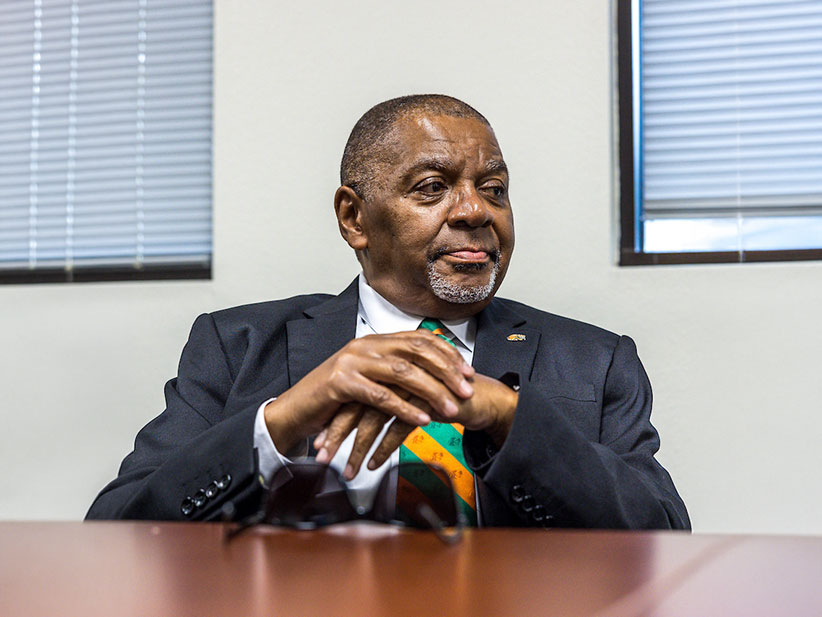 Title III Executive Director Eric Akins emphasizes that support is critical to expanding
faculty capabilities and advancing toward R1 status. (Photo by Jeff Adams/FAMU)
Title III Executive Director Eric Akins emphasizes that support is critical to expanding
faculty capabilities and advancing toward R1 status. (Photo by Jeff Adams/FAMU)
According to Akins, the things that limit researchers are often the resources on the
table to help them accomplish what they need to do. “When we talk about trying to
get to R1, these are the investments we need to make to have an impact on the University,”
he said.
In Akins' mind, the calculation was simple: FAMU had an opportunity to place its faculty and students in a consequential area of research, and the University needed the infrastructure to make that opportunity real.
“If you build it, they will come,” he said. “If we build it, and we have it, that will open a lot of doors for us.”
Those doors could lead to new grants, partnerships, discoveries and a stronger pipeline of doctoral students. Under the Carnegie Classification’s 2025 methodology, an institution reaches Research 1 status by recording at least $50 million in annual research and development spending and awarding at least 70 research doctorates annually, based on the higher of the most recent year or a three-year average. Weatherford said FAMU has exceeded the research-spending threshold in recent years. Increasing doctoral degree production remains the larger challenge.
Facilities such as the quantum laboratory help address both measures. Competitive grants expand research activity, while specialized equipment helps attract faculty and graduate students who want to work where the future is taking shape. Their work can generate doctoral degrees, publications, patents, partnerships and the next round of external funding.
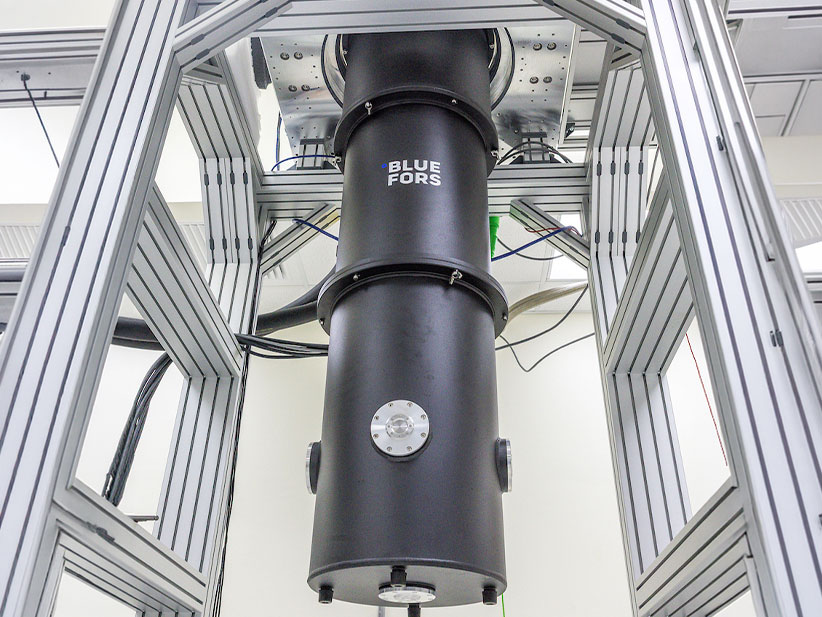 FAMUs new quantum refrigerators can make the impossible possible. (Photo by Jeff Adams/FAMU)
Weatherford pointed to Jessica Tucker, Ph.D., his recent FAMU Ph.D. graduate, who conducted her quantum computing research at Lawrence Livermore National Laboratory in California, supported by his National Nuclear Security grant. FAMU’s new local capacity can give more students meaningful experience on campus while connecting them to a national research network.
The work ahead will be measured and methodical: install the chip, control the qubits, study what goes wrong and try again. That is how frontier science advances, one carefully tested question at a time.
Media Contact
Rachel James-Terry
Senior Director of Strategic Communications
rachel.jamesterry@famu.edu