
FAMU and 2150 Center for Innovation Expand iLab Collaboration to Advance AI-Driven Campus and Community Development
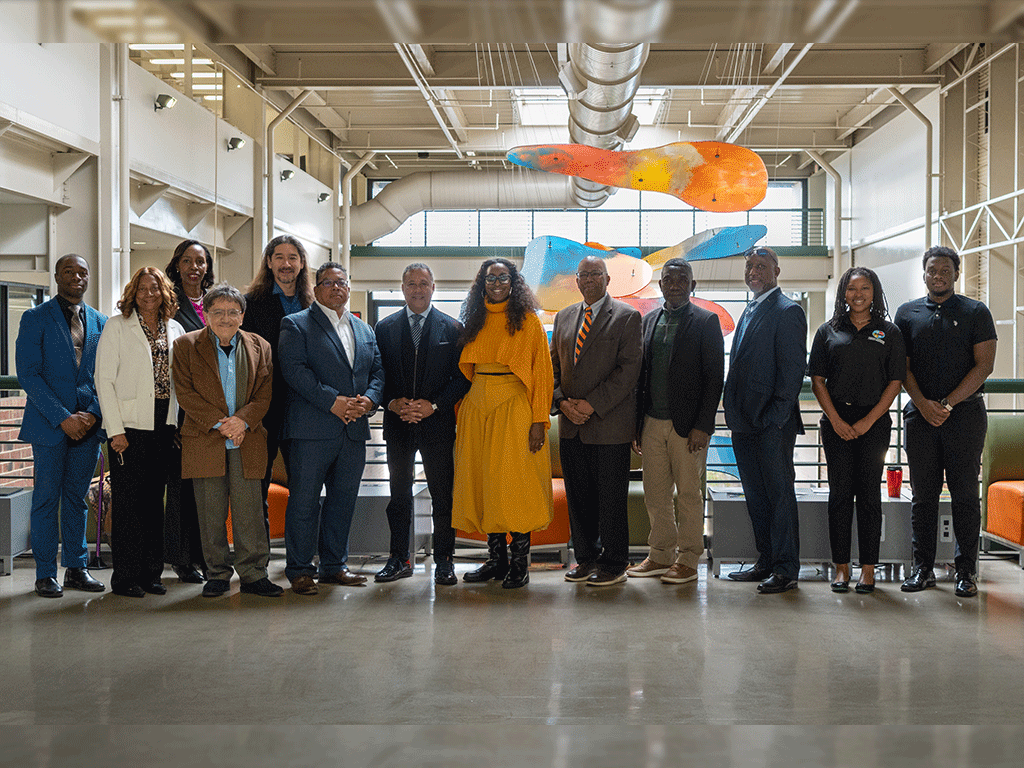
Tallahassee, Fla.— Florida A&M University (FAMU) and the 2150 Center for Innovation are expanding their collaboration to launch a new phase of the iLAB problem-solving initiative focused on using artificial intelligence to transform campus infrastructure, amenities, and athletic facilities into platforms for economic development, entrepreneurship, and community engagement.
The expanded collaboration builds on ongoing work by FAMU students, faculty, and staff who are participating in an artificial intelligence–driven design project to reimagine the Moore-Kittles Baseball Complex using advanced AI planning and visualization technologies. Developed through the iLAB model, the project demonstrates strong potential to evolve into a data-driven startup while providing students with hands-on experience applying emerging technologies to real-world campus challenges.
“We believe campuses can be engines of entrepreneurship when real problems drive the work,” said Erskine “Chuck” Faush, CEO of the 2150 Center for Innovation. “By turning infrastructure challenges into innovation opportunities, universities can help create startups that are grounded in demand, tested in real environments, and built to scale.”
Faush noted that Florida A&M University exemplifies the type of academic excellence and mission-driven leadership required to make industry-aligned innovation successful.
From Infrastructure Challenges to Startup Opportunities
Central to the partnership is a shared vision to position the university as a “communiversity”—a living innovation ecosystem where academic talent, industry expertise, and community stakeholders collaborate to co-create solutions that generate both social value and scalable business opportunities.
“Higher education is uniquely positioned to lead applied innovation because it brings together talent, research, and real environments,” said Provost and Vice President for Academic Affairs Allyson L. Watson, Ph.D. “This collaboration allows students and faculty to move beyond theory and actively design solutions that strengthen both the university and the communities we serve.”
As part of this effort, the FAMU iLAB team recently hosted 2150 Center representatives to explore strategies for elevating campus and athletic facilities as hubs for engagement, entrepreneurship, and economic inclusion. The nine-member team consists of four undergraduate engineering students, two graduate-level architecture students, two faculty mentors, and one faculty consultant from the FAMU School of Architecture and Engineering Technology and the FAMU-FSU College of Engineering.
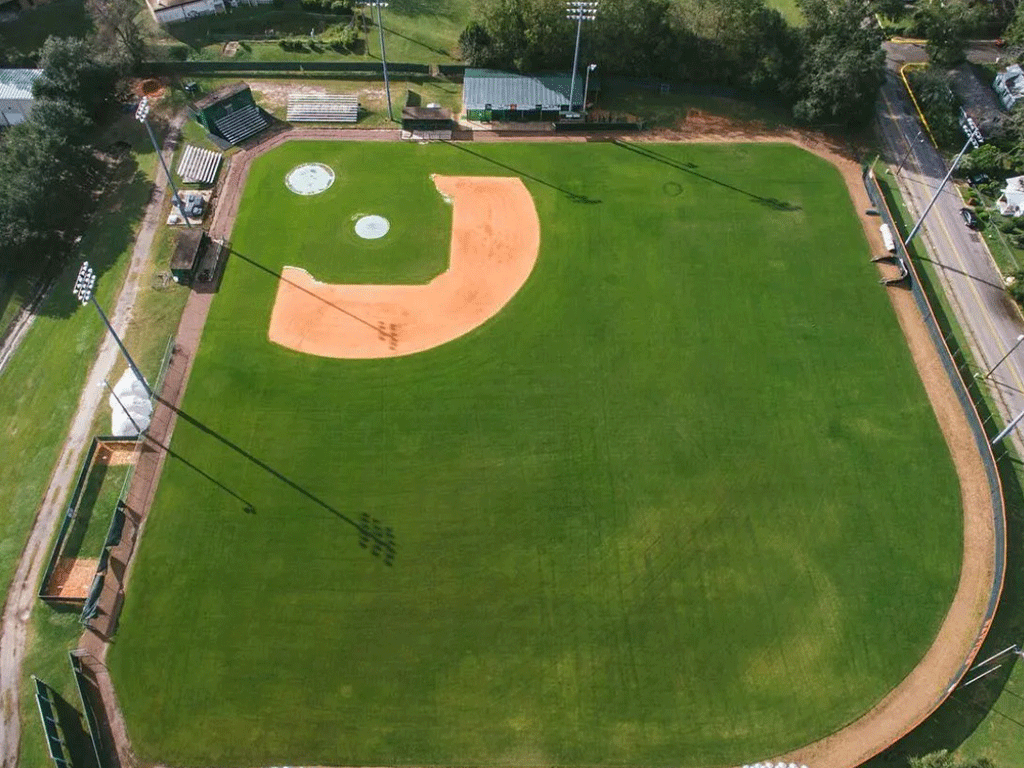 The FAMU baseball field is the campus project site that the FAMU iLab team is refershing
using AI tools. (Photo by Wesley Connell)
The FAMU baseball field is the campus project site that the FAMU iLab team is refershing
using AI tools. (Photo by Wesley Connell)
The iLAB Model for AI-Powered Economic Development in Action
Through the iLAB model, real-world campus needs—including facilities optimization, energy efficiency, fan and community engagement, safety, health, and digital amenities—serve as the foundation for applied innovation and venture development. Multidisciplinary teams of students, faculty, and industry experts design, prototype, and test AI-enabled solutions that can be deployed on campus and scaled beyond it.
“By using our campus infrastructure as a real-world innovation environment, we are creating opportunities for students and faculty to solve meaningful problems while gaining valuable experience in the use of generative AI tools,” said Reginald Perry, Ph.D., associate provost for academic and faculty affairs, who is guiding the FAMU iLAB project.
Jackson Norflis, a second-year industrial engineering student from Atlanta, said the experience is helping him build skills applicable to complex challenges across industries.
“My experience during the 2150 Center for Innovation campus visit was phenomenal,” said Norflis. “I gained a deeper understanding of the scale of our project and received valuable guidance from prominent leaders in my field.”
Looking Ahead: A Scalable Model for HBCU-Led Innovation
By fall 2026, the team will use AI tools to advance project development and present a completed architectural refresh design for FAMU’s baseball complex, originally constructed more than 40 years ago.
The expanded collaboration between FAMU and the 2150 Center for Innovation demonstrates how HBCUs can lead in AI-powered economic development, not only as talent producers but as builders of companies, platforms, and innovation ecosystems. The initiative offers a scalable blueprint for institutions seeking to align infrastructure, investment, academic excellence, entrepreneurship, and community impact.
For more information about the FAMU iLAB project, contact provostcomm@famu.edu.
About 2150 Center for Innovation, Commercialization & Growth
2150 is a public-private innovation and talent-development platform that connects HBCU students and emerging entrepreneurs with corporate and civic partners who tackle urgent, real-world challenges. The 2150 iLabs model translates partner-defined problems into student-led solution development supported by a structured cohort curriculum, mentorship, and an ecosystem of professional services. By aligning applied learning with workforce demand and market viability, 2150 helps partners pilot solutions, strengthen talent pipelines, and expand inclusive innovation in communities. Visit 2150innovate.org.
Media Contact
Rachel James-Terry
Senior Director of Strategic Communications
rachel.jamesterry@famu.edu
Deidre Williams
Director of Communications
Office of the Provost
deidre.williams@famu.edu