
FAMU celebrates 50 years of entomology training and industry connections
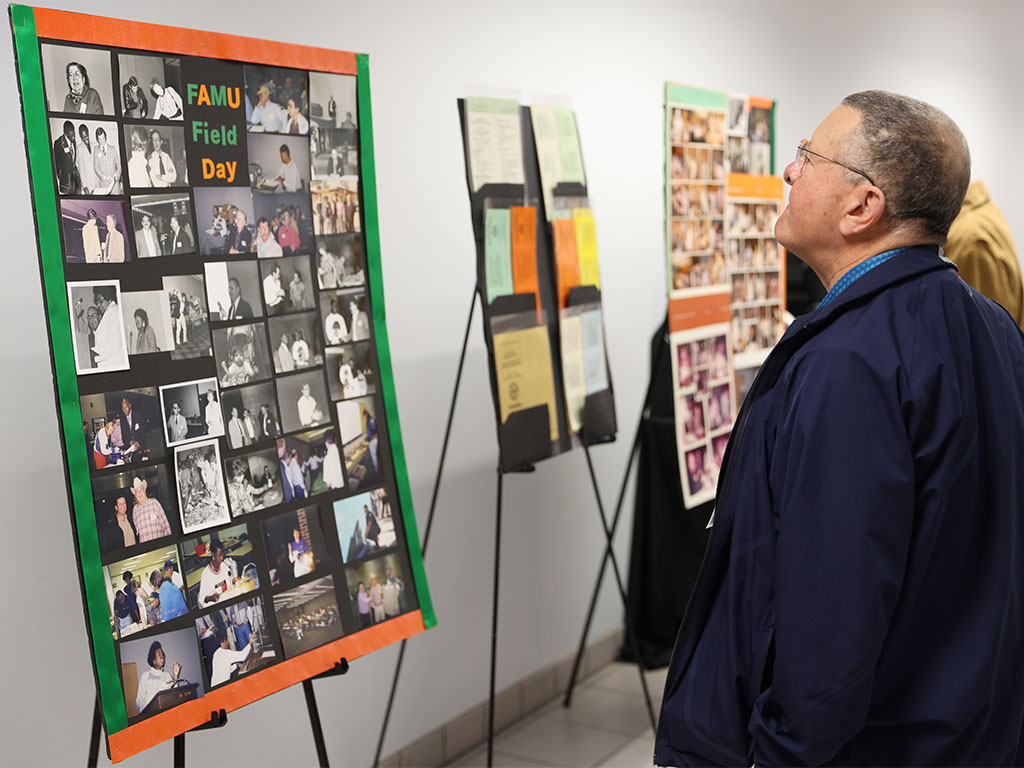
TALLAHASSEE, Fla. - Florida A&M University celebrated the 50th anniversary of its annual entomology workshop
Nov. 4–5, highlighting a legacy of helpingbringing pest management professionals maintain
theirtogether for continuing education credentials whileand connecting students with
careers in the industry.
FAMU’s Entomology entomology Program program in the College of Agriculture and Food
Sciences, in cooperation with the Division of Continuing Education, hosted the William
L. Peters Annual Field Day and Workshop in Entomology at Tallahassee State College’s
Workforce Development Building.
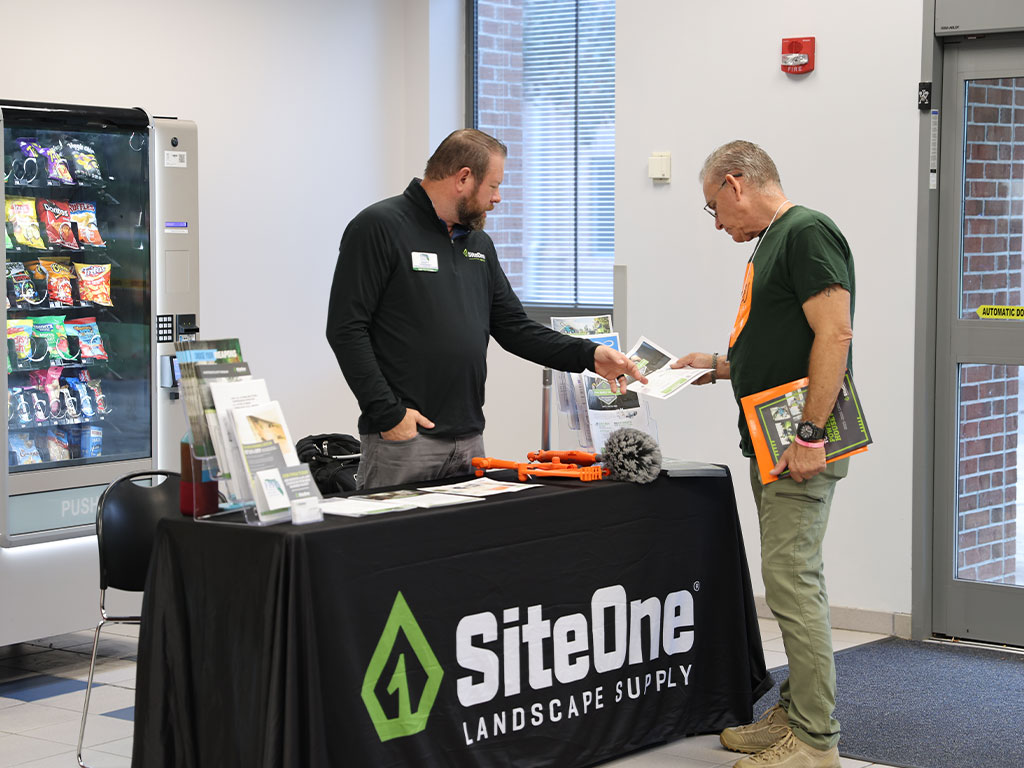 A SiteOne Landscape Supply representative shares product information with an attendee
during FAMU’s 50th annual entomology workshop, connecting participants with industry
resources and professional development opportunities. (Photo by Jacquez Daniels)
The two-day event brought together professionals, researchers and students for training
on pesticide safety, emerging pests and new technologies. As FAMU’s longest-running
continuing education program, the workshop connects university research with practical
approaches to protecting homes, businesses, agriculture and public health.
John Dukes III, Ph.D., chair of the workshop’s advisory council, described the event
as a one-stop resource for professionals seeking to maintain credentials across multiple
states.
“This is one of the few places you can get a quality education and get all the certification
you need for your state because we have the rights and meet the standards for various
states with a blend of required hours,” Dukes said.
Sessions on Nov. 4 focused on core pesticide education, public health and fumigation. On Nov. 5, training addressed lawn and ornamental pest management, core pesticide education, general household pests and wood-destroying organisms.
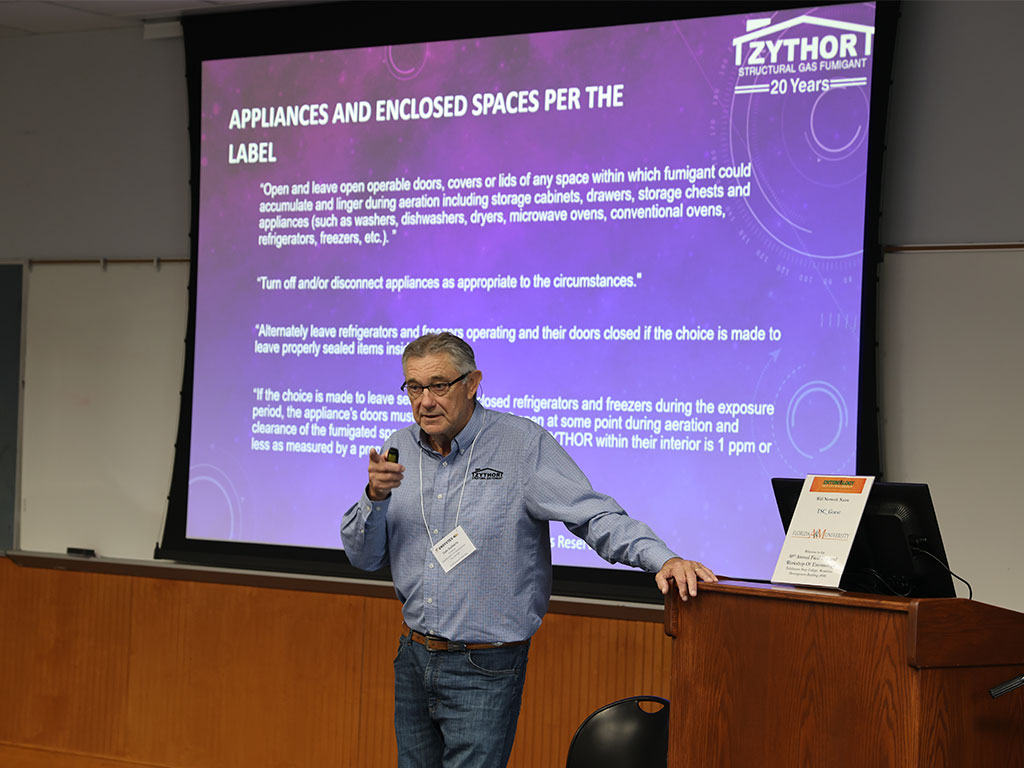 A speaker reviews fumigation procedures and safety guidelines during FAMU’s annual
entomology workshop, which brought together pest management professionals, researchers
and students for two days of training. (Photo by Jacquez Daniels.)
In addition to Florida’s continuing education categories, organizers Organizers also
requested continuing education credit approval for professionals licensed in Alabama,
Georgia, Mississippi, Louisiana, South Carolina, North Carolina, Tennessee and Virginia.
The program addressed pesticide application in sensitive environments, invasive mosquitoes, vector-borne diseases, and cockroach and termite control. Presentations also explored technologies that could help professionals identify pests and respond to emerging threats.
Lambert Kanga, Ph.D., professor and chair of FAMU’s entomology program, said the workshop
connects researchers studying unfamiliar species with pest control specialists who
can put new knowledge into practice.
“One of the challenges we have is invasive species that we haven’t encountered before,”
Kanga said. “AI can be used to identify termites and other insects, which we can use
to make predictions.”
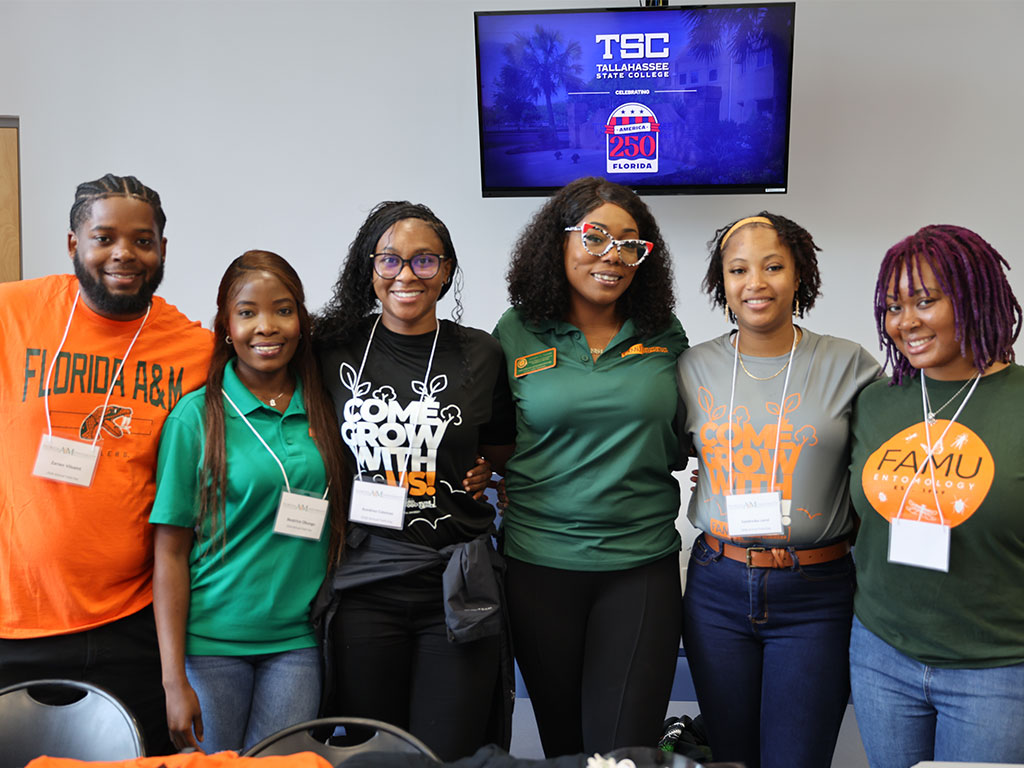 Participants gather for a group photo during FAMU’s 50th annual entomology workshop,
celebrating five decades of education, industry connections and professional development.
(Photo by Jacquez Daniels)
That exchange between research and practice also exposed students to the questions
scientists and business owners are working to answerStudents also learned about the
challenges researchers and pest management professionals face.
Latasha Tanner, a FAMU alumna and research associate who works in outreach for the
entomology program, said the workshop helps students connect their academic preparation
with employment opportunities.
“Workshops like these give our students the opportunity to meet the industry makers,
see who is really hiring, and the different innovations in regard to pest control,”
Tanner said. “It gives an understanding of the products we might not think are important
but have a significant difference in making sure our agriculture, homes, and wherever
we do business is safe.”
For Jacquez Daniels, a FAMU entomology graduate student, learning directly from researchers
and business owners offered guidance and motivation.
“It’s a good opportunity for students to come and see pest management professionals,
hear their talks, get inspired, and strive for careers in urban entomology and pest
management and the industry overall,” Daniels said.
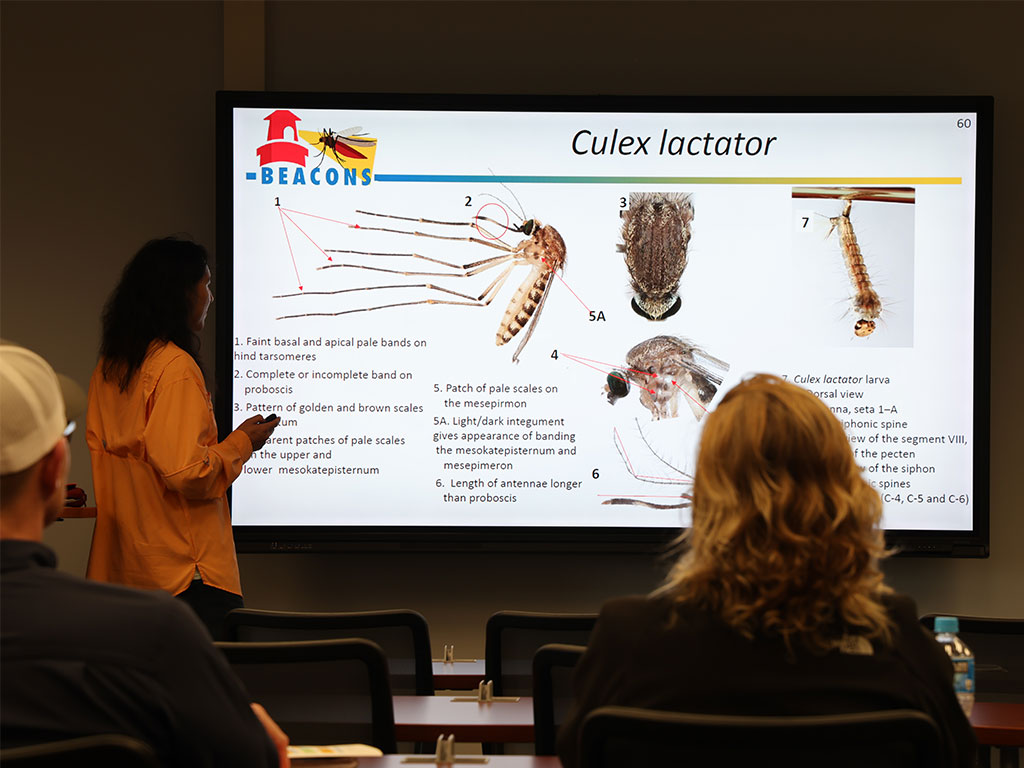 A presenter explains identifying characteristics of the mosquito species Culex lactator
during FAMU’s 50th William L. Peters Annual Field Day and Workshop in Entomology at
Tallahassee State College. (Photo by Jacquez Daniels)
Those connections reflect the workshop’s origins. Its roots trace to The workshop
began in the mid-1970s and efforts to bring university expertise and practical experience
to pest management professionals. William L. Peters recruited Tallahassee pest management
professional Reuben Capelouto to teach at FAMU, where he introduced students to the
scientific and business sides of entomology.
The commitment to students continued after Capelouto’s death in 1980, when his family
established the Reuben Capelouto Foundation to support entomology education at FAMU.
Scholarship awards presented through the workshop have helped students cover tuition,
books and other educational expenses, extending his legacy beyond the classroom.
Over the years, Field Daythe workshop has also created opportunities for researchers,
industry experts and graduate students to exchange knowledge and expand professional
connections.
The anniversary celebration recognized longtime supporters and leaders who helped
shape the event. A commemorative magazine, video presentation and auction highlighted
the program’s history and growth.
As organizers reflected on that history, they also considered how to reach more people.
Anamika Sharma, Ph.D., event director, said the next chapter includes expanding hands-on
training and creating more opportunities for professionals to participate online.
“The future is getting more workshops done, having more hands-on opportunities, and
having more online activities and webinars to make these kinds of events more accessible
to people, and we can do it if we had even more people and more funding,” Sharma said.
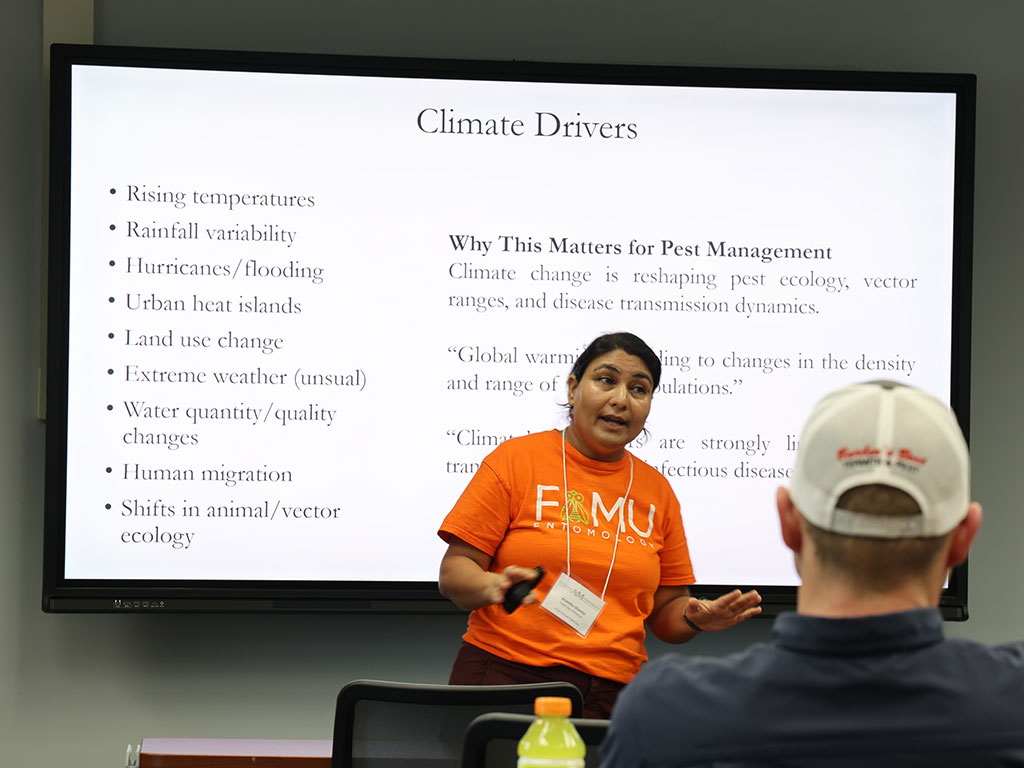
Anamika Sharma, Ph.D., discusses how climate change affects pest ecology and management during FAMU’s 50th William L. Peters Annual Field Day and Workshop in Entomology, held Nov. 4–5 at Tallahassee State College. Photo by Jacquez Daniels.
Media Contact:
Ashley Flete
Senior Communications Specialist
ashley1.flete@famu.edu