
FAMU Entomologist Honored for Advancing Sustainable Pest Management Education Across the South

National recognition highlights the growing importance of Integrated Pest Management amid rising pest pressures nationwide
Florida A&M University (FAMU) faculty member Muhammad Haseeb, Ph.D., has received the 2026 Friends of IPM “IPM Educator” Award, a national honor recognizing long-term excellence in teaching and advancing Integrated Pest Management (IPM) practices across the Southern region.
An associate professor of entomology in FAMU’s College of Agriculture and Food Sciences (FAMU CAFS) and director of the Center for Biological Control, Haseeb has been recognized for more than two decades of leadership in educating students, growers, extension professionals, exchange scholars, and communities on sustainable pest management strategies.
“Dr. Haseeb’s work demonstrates how research, education, and community engagement can directly support agricultural resilience and environmental sustainability,” said G. Dale Wesson, Ph.D., dean, FAMU CAFS. “As an 1890 land-grant institution, FAMU has a responsibility to deliver research-based solutions that address real-world challenges impacting farmers, communities, and food systems. His contributions reflect that mission in action.”
Addressing a Growing National Challenge
The recognition comes at a critical time, as agricultural producers and communities nationwide face increasing pest pressures linked to warmer temperatures, the expansion of invasive species, and shifting environmental conditions. The U.S. Department of Agriculture has warned that rising temperatures and shifting weather patterns are increasing the distribution and severity of insects, weeds, plant and animal diseases affecting agricultural systems across the country.
Integrated Pest Management is a science-based approach that combines biological, cultural, physical, and targeted control methods to manage pests while minimizing environmental, economic, and social risks. Rather than relying solely on chemical treatments, IPM emphasizes pest monitoring, prevention, and sustainable decision-making.
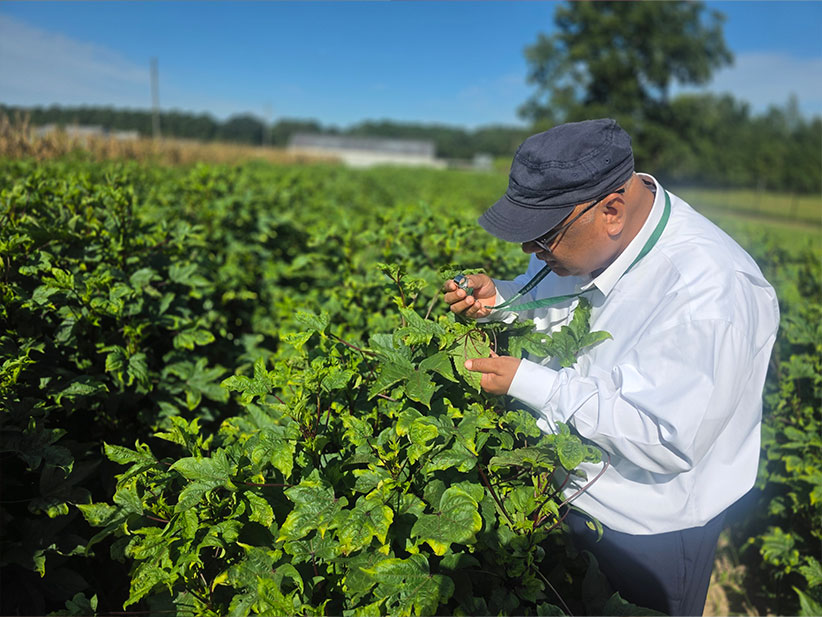 Muhammad Haseeb, Ph.D., working at FAMU Research and Extension Center (REC) in Quincy,
Florida, observing a newly introduced species of two-spot cotton leafhopper, a serious
invasive pest of specialty crops in Fall 2025. (Photo special to FAMU)
Muhammad Haseeb, Ph.D., working at FAMU Research and Extension Center (REC) in Quincy,
Florida, observing a newly introduced species of two-spot cotton leafhopper, a serious
invasive pest of specialty crops in Fall 2025. (Photo special to FAMU)
Advancing Sustainable Agriculture Through Research and Education
Haseeb specializes in pest management for economically important specialty crops, including blueberries, tomatoes, peppers, and strawberries. These commodities are economically important throughout the South. His teaching and outreach efforts focus on helping growers identify pests early, implement biological controls, and make data-informed management decisions that reduce unnecessary pesticide use.
“Integrated Pest Management is ultimately about helping communities make informed, sustainable decisions that protect crops, natural resources, and public health,” said Haseeb. “Through teaching, research, and extension outreach, our goal is to equip students and agricultural stakeholders with practical, science-based strategies that can address both current pest challenges and emerging threats facing our food systems.”
For more than 24 years, Haseeb has supported FAMU’s land-grant mission through teaching, applied research, and extension engagement. He teaches undergraduate and graduate courses centered on pest identification, biological control, pest monitoring, and sustainable agricultural practices using hands-on, problem-solving instruction.
Preparing the Next Generation of Agricultural Leaders
Many of his former students now serve in leadership positions within extension systems, state agencies, and private industry, where they continue implementing IPM strategies in agricultural and environmental settings. Jermaine Perier, Ph.D., a former student, shared that Hasseeb’s teaching effectively prepared him for the workforce. He is now an assistant professor at Mississippi State University’s Central Mississippi Research and Extension Center.
“Dr. Haseeb’s vision for pest management challenged us to think beyond simply treating insect pests and instead encouraged an understanding of the full agricultural ecosystem for long-term management,” said Perier. “Through his mentorship, many of us learned how to lead with science-based approaches that support growers, serve the public, and promote environmental sustainability.”
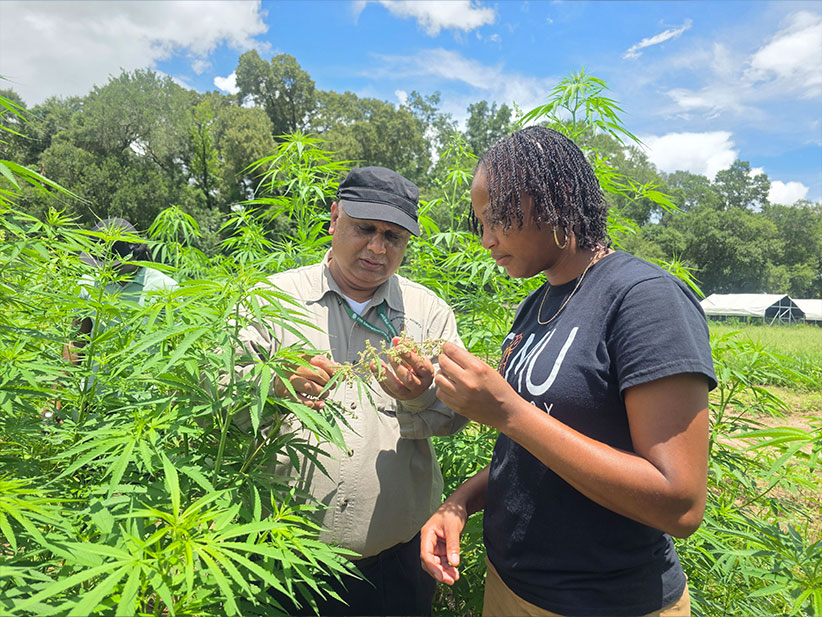 Muhammad Haseeb, Ph.D., and graduate student, Sandreika Laird, observing hemp inflorescence
for insect pollinators at FAMU, REC in Quincy, Florida, Fall 2025. (Photo special
to FAMU)
Muhammad Haseeb, Ph.D., and graduate student, Sandreika Laird, observing hemp inflorescence
for insect pollinators at FAMU, REC in Quincy, Florida, Fall 2025. (Photo special
to FAMU)
Beyond the classroom, Haseeb has led workshops, scientific symposia, and field demonstrations for growers, extension agents, and Master Gardeners throughout the region. He has also developed bilingual educational materials designed to expand access to research-based pest management information across diverse agricultural communities.
A Lasting Impact in the Southern Region
The Friends of IPM Award recognizes individuals who have demonstrated exceptional dedication to advancing Integrated Pest Management education and encouraging the adoption of sustainable pest management practices throughout the Southern region.
Haseeb’s scholarly and outreach portfolio includes 93 publications, including 74 peer-reviewed research articles and 19 extension and outreach publications.
Media Contact:
Rachel James-Terry
Senior Director of Strategic Communications
rachel.jamesterry@famu.edu
Deidre Williams
Director of Communications, Academic Affairs
deidre.williams@famu.edu