
FAMU Researchers Use AI to Advance Hurricane Preparedness
TALLAHASSEE, Fla. - As Florida rolls through another active hurricane season, researchers at Florida A&M University's (FAMU) School of the Environment (SOE) are looking beyond weather forecasts to better understand how storms impact communities long after the winds and rain have passed.
Through the university's Center of Excellence for Indoor Air Quality, faculty and students are using artificial intelligence (AI), environmental sensors and real-time data to monitor indoor air quality before, during and after severe weather events. This provides valuable information that can strengthen campus resilience, improve public health and better prepare communities for future storms.
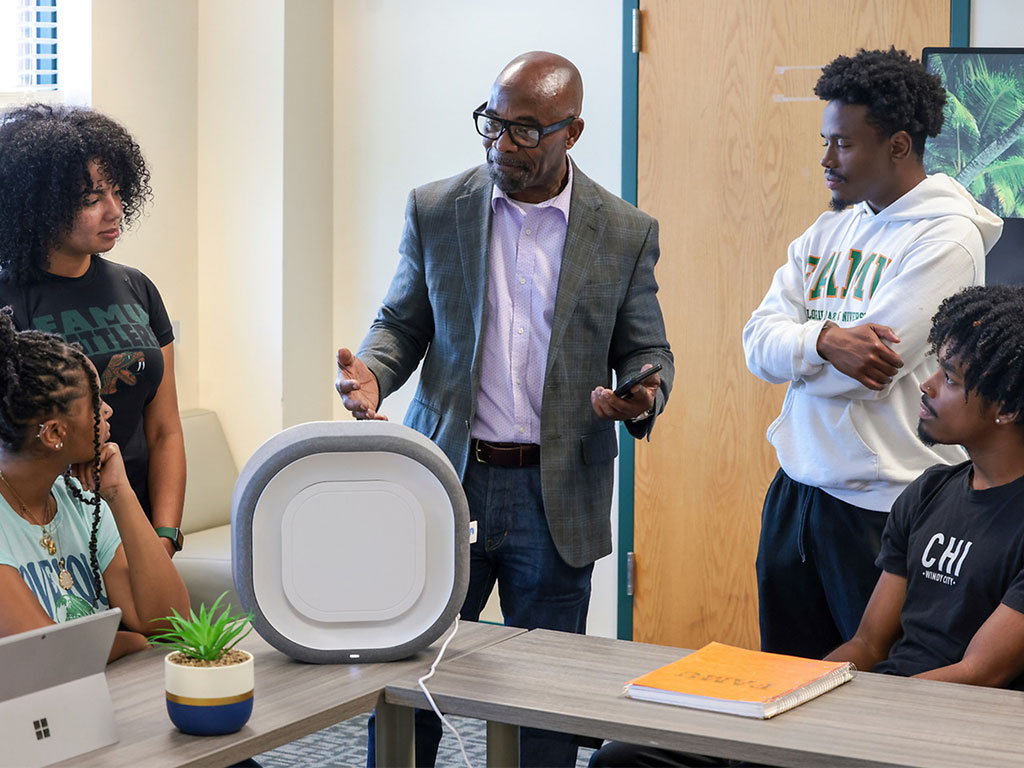 Victor Ibeanusi, Ph.D., dean of Florida A&M University's School of the Environment,
discusses the capabilities of the Center of Excellence for Indoor Air Quality's environmental
monitoring sensor with students. The technology collects real-time data that supports
research in hurricane preparedness, climate resilience and public health while providing
students with hands-on learning experiences. (Photo courtesy of Florida A&M University.)
Victor Ibeanusi, Ph.D., dean of Florida A&M University's School of the Environment,
discusses the capabilities of the Center of Excellence for Indoor Air Quality's environmental
monitoring sensor with students. The technology collects real-time data that supports
research in hurricane preparedness, climate resilience and public health while providing
students with hands-on learning experiences. (Photo courtesy of Florida A&M University.)
Leading the effort is Victor Ibeanusi, Ph.D., dean of the School of the Environment, who said the technology allows researchers to collect continuous environmental data while preparing students to address real-world environmental challenges.
"For us, AI is only valuable if it provides actionable insights that help us make informed decisions," Ibeanusi said. "The data we collect before and after a hurricane allows us to understand what has changed and identify ways to better protect our campus and surrounding communities."
The university recently expanded its monitoring capabilities by deploying 20 additional sensors across campus in partnership with FAMU Environmental Health and Safety.
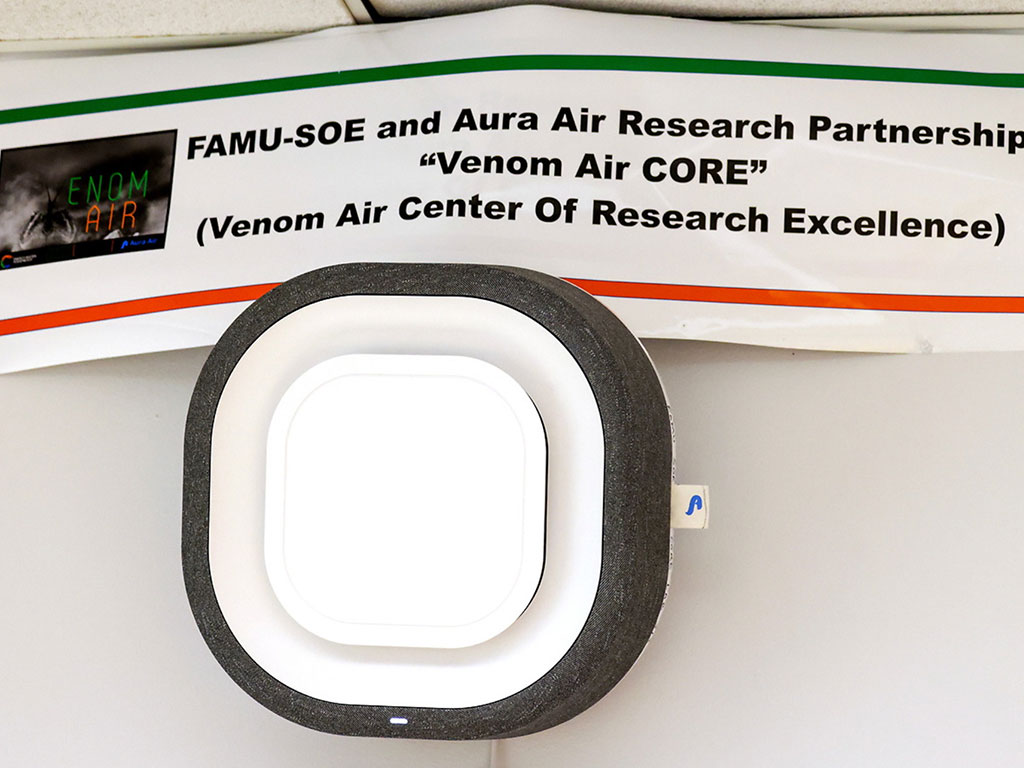
The Center of Excellence for Indoor Air Quality's environmental monitoring sensor
is used by researchers and students in Florida A&M University's School of the Environment
to collect real-time data on temperature, humidity, particulate matter and other air
quality indicators. The technology supports research focused on hurricane preparedness,
climate resilience and public health. (Photo courtesy of Florida A&M University.)
The school's growing network of environmental sensors measures temperature, humidity,
particulate matter and volatile organic compounds, commonly known as VOCs. The information is transmitted in real time to the School of the Environment's Core
Laboratory, where researchers analyze environmental conditions through interactive
dashboards and geographic information systems (GIS) to identify trends and areas of
concern.
The expanded network will provide researchers with broader environmental data while
strengthening the university's ability to assess indoor air quality before and after
major weather events.
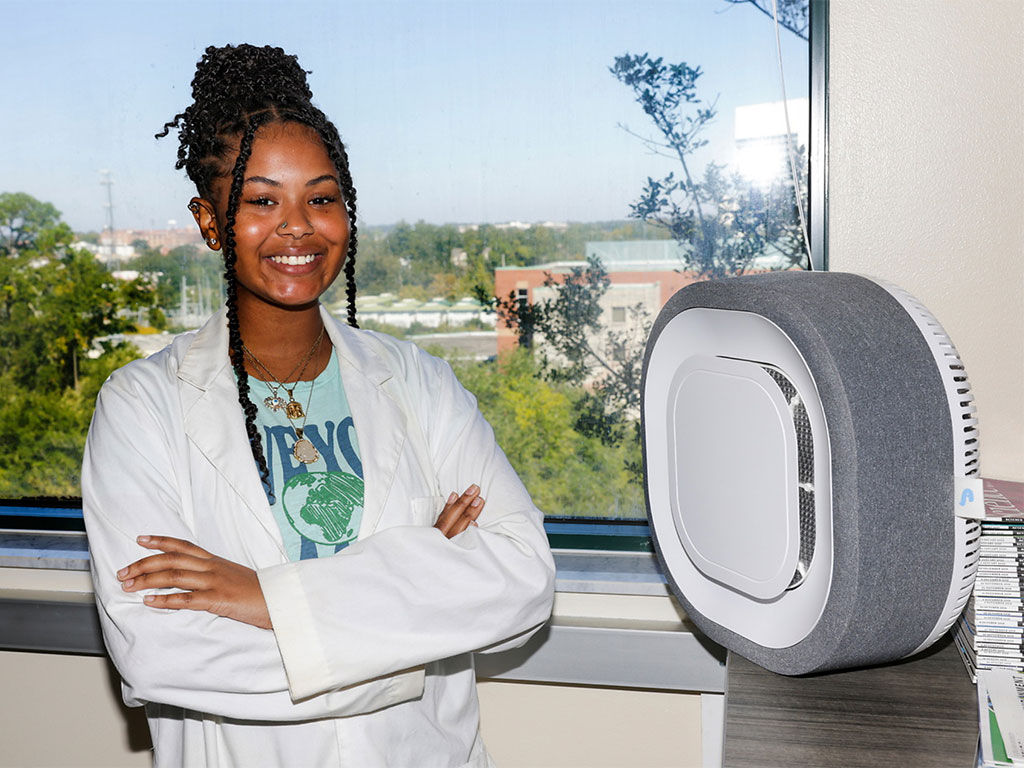
A Florida A&M University School of the Environment student demonstrates one of the
air quality sensors used to monitor environmental conditions in real time. (Photo
courtesy of Florida A&M University.)
One area of particular interest is airborne particulate matter, microscopic particles that can increase following hurricanes and severe weather. According to Ibeanusi, tracking these particles allows researchers to better understand how changing environmental conditions may influence public health.
"Hurricanes don't just bring heavy rain and strong winds," Ibeanusi said. "Understanding how environmental conditions change before and after a storm helps us make better decisions about health, safety and recovery."
Beyond fixed monitoring stations, the SOE is expanding the use of its geospatial mobile laboratory, allowing researchers and students to bring environmental monitoring directly to affected areas. The mobile lab supports environmental assessments, public health initiatives and disaster response while giving students hands-on experience with emerging technologies used throughout the environmental workforce.
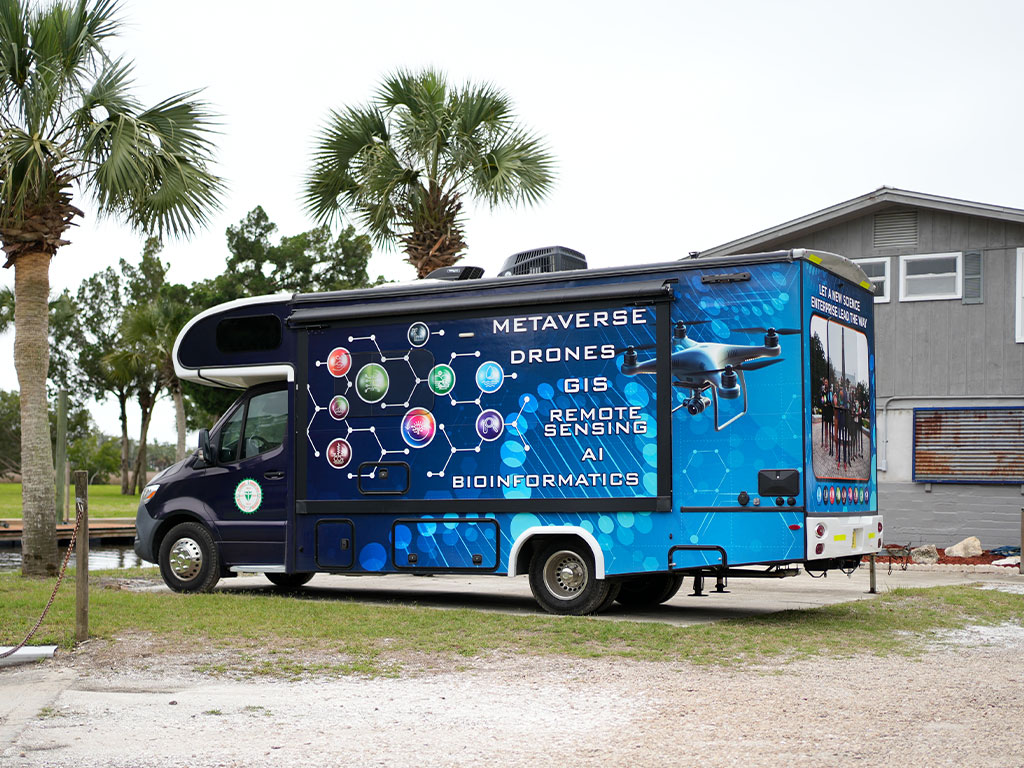
Designed to bring research directly to the source, Florida A&M University's Mobile
AI Laboratory allows students and faculty to monitor environmental conditions, analyze
real-time data and support community-based research related to hurricane preparedness,
climate resilience and public health. (Photo courtesy of Florida A&M University.)
"We have to train students using real-world applications," Ibeanusi said. "It cannot
just be talking about these concepts in the classroom. Students need opportunities
to work with the data, understand the technology and develop solutions."
That commitment to experiential learning is reflected in the success of alumni like Autumn Dancy, a meteorologist at ABC 20 in Gainesville, Florida, whose career demonstrates how the School of the Environment prepares graduates to communicate complex environmental and weather issues to the public. Dancy said FAMU's interdisciplinary curriculum gave her both the scientific knowledge and communication skills she relies on every day.
"My passions have always been the Earth and all of its processes, but especially the role communication plays in helping the public understand both the beauty of this planet and the challenges it faces, and the weather that we all live through every day together," Dancy said.
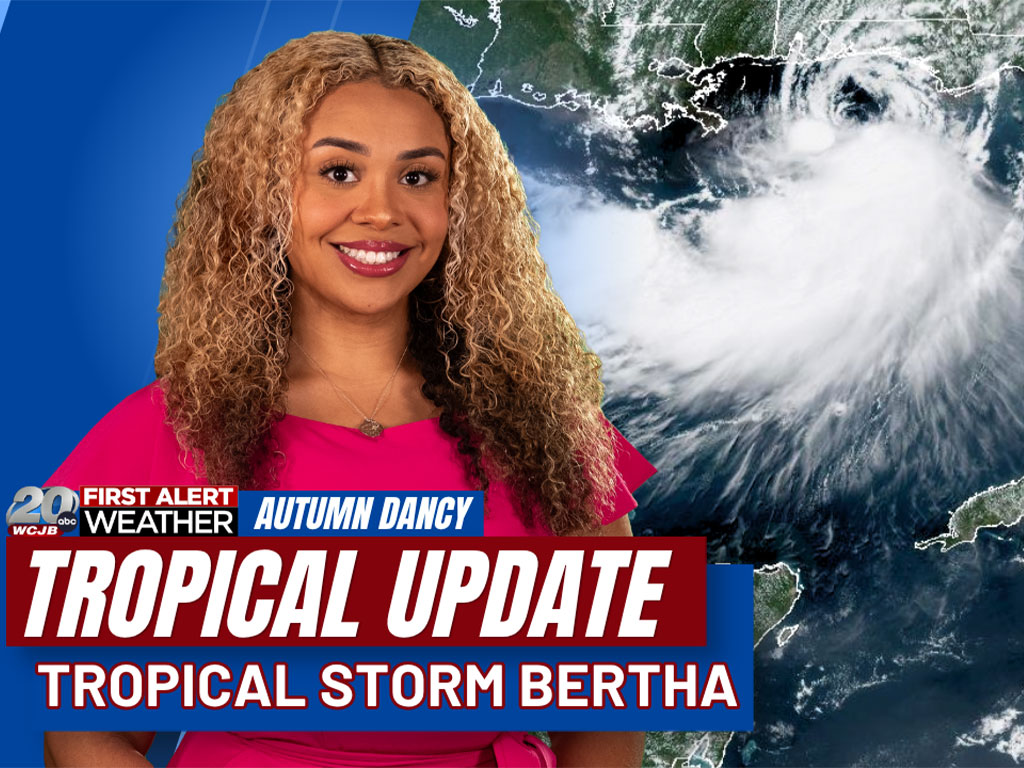
Autumn Dancy, a Florida A&M University School of the Environment alumna and meteorologist
for WCJB ABC 20 in Gainesville, Florida, credits her hands-on research experiences
and interdisciplinary education at FAMU with preparing her to communicate complex
weather and environmental issues to the public. (Photo courtesy of Autumn Dancy.)
She credits the School of the Environment's faculty with providing a strong scientific
foundation in atmospheric processes, chemistry, biology, botany and animal sciences
while creating opportunities for students to gain valuable hands-on experience through
laboratory courses and field research.
"When it comes to forecasting the weather and communicating current conditions, understanding the science is the most important part," Dancy said. "People have questions and turn to you for answers, so you need to be knowledgeable."
Outside the classroom, Dancy served as the university's first president of the Sustainability Club, helping launch initiatives including a campus recycling program in residence halls and expanding sustainability efforts through the School of the Environment's garden.
She also participated in the National Oceanic and Atmospheric Administration (NOAA) scholarship program, where research opportunities exposed her to environmental challenges similar to those she now reports on professionally.
"One research expedition took us to Corpus Christi, Texas, to study drought conditions and possible solutions," Dancy said. "Now that I'm working in Florida, where we've experienced severe drought conditions, that experience prepared me to communicate those environmental changes to my community in a way people can understand."
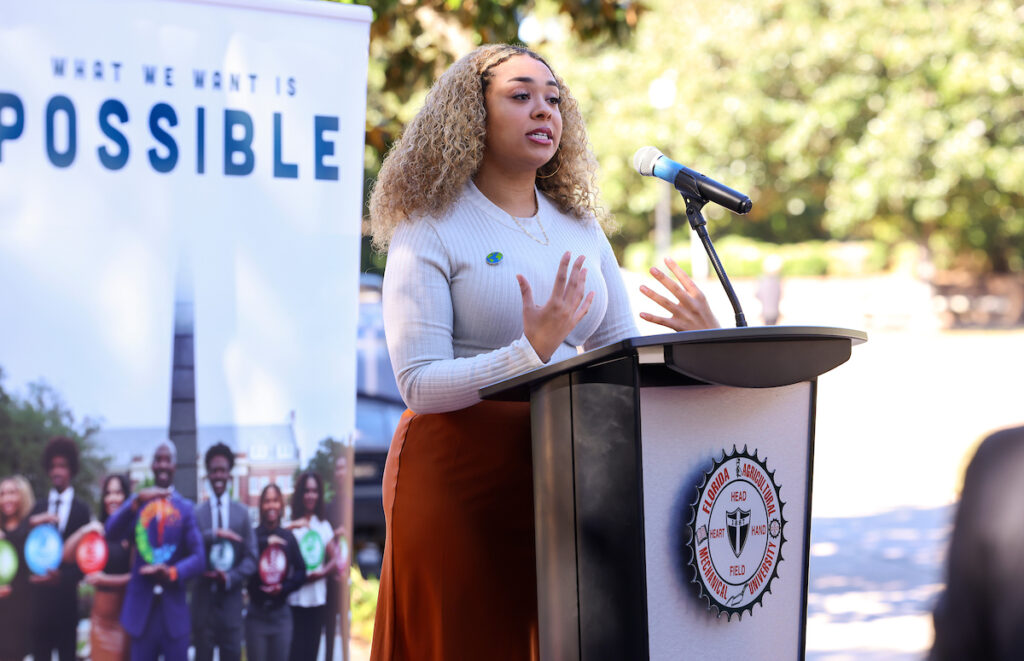 Florida A&M University School of the Environment alumna Autumn Dancy addresses attendees
during a speaking engagement. Now a meteorologist for WCJB ABC 20 in Gainesville,
Dancy says her FAMU education provided the scientific foundation and communication
skills she uses daily to inform the public about weather and environmental conditions.
(Photo Courtesy of FAMU.)
Florida A&M University School of the Environment alumna Autumn Dancy addresses attendees
during a speaking engagement. Now a meteorologist for WCJB ABC 20 in Gainesville,
Dancy says her FAMU education provided the scientific foundation and communication
skills she uses daily to inform the public about weather and environmental conditions.
(Photo Courtesy of FAMU.)
Ibeanusi said those experiences are exactly what the SOE strives to provide. More than 300 students across campus have participated in sustainability and environmental resilience initiatives, preparing graduates for careers in environmental science, public health, engineering, communications and related fields.
The research also supports FAMU's broader vision of becoming a leader in climate resilience by combining innovative research, artificial intelligence and interdisciplinary collaboration to address some of society's most pressing environmental challenges.
"This positions FAMU as a climate resilience campus," Ibeanusi said. "We're using technology, data and research to better understand environmental challenges while preparing the next generation of leaders to solve them."
That work will continue this fall through the Europe-U.S. Climate Resilience Forum, which will bring together researchers, students and international partners to explore collaborative solutions related to climate change, extreme heat and disaster preparedness.
The forum will encourage interdisciplinary collaboration among environmental scientists, engineers, architects, business leaders, public health professionals and communicators to develop innovative strategies for building more resilient communities.
For Dancy, the SOE’s mission extends beyond preparing students for careers—it prepares them to make a lasting impact.
"The data shows that Earth needs our help," she said. "As scientists, it's our mission to serve both the planet and its people."
Now pursuing her master's degree while working as a meteorologist, Dancy encourages future environmental scientists to embrace the opportunities available through the School of the Environment.
"If you want to be a scientist," she said, "SOE is the place to be."
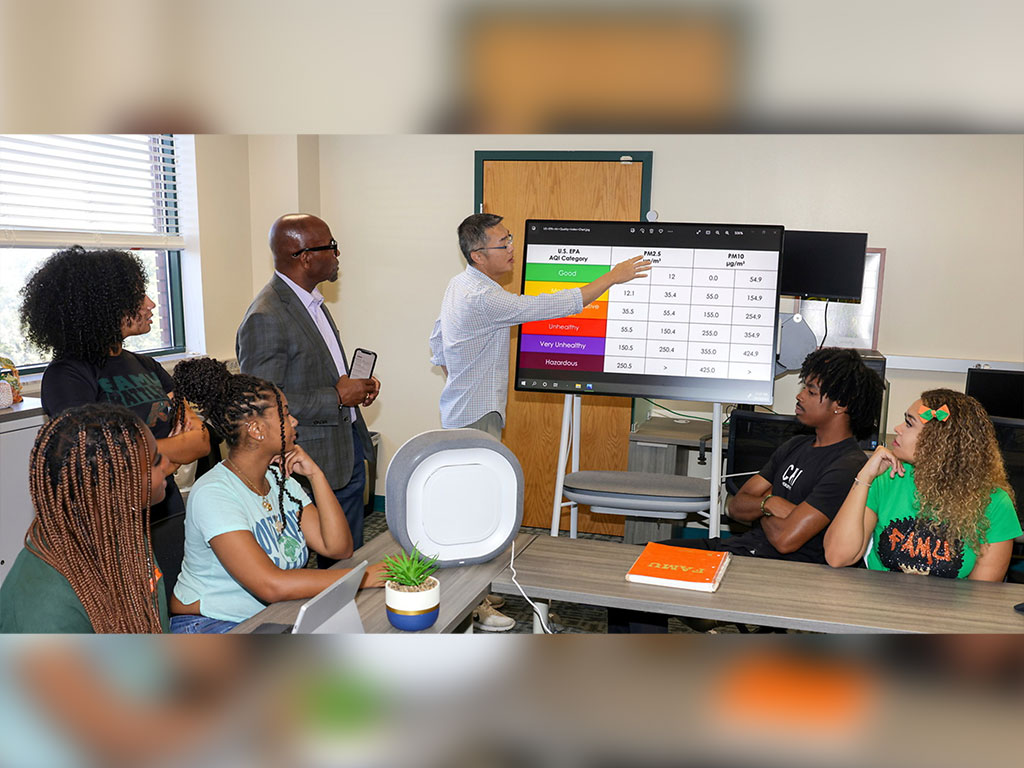
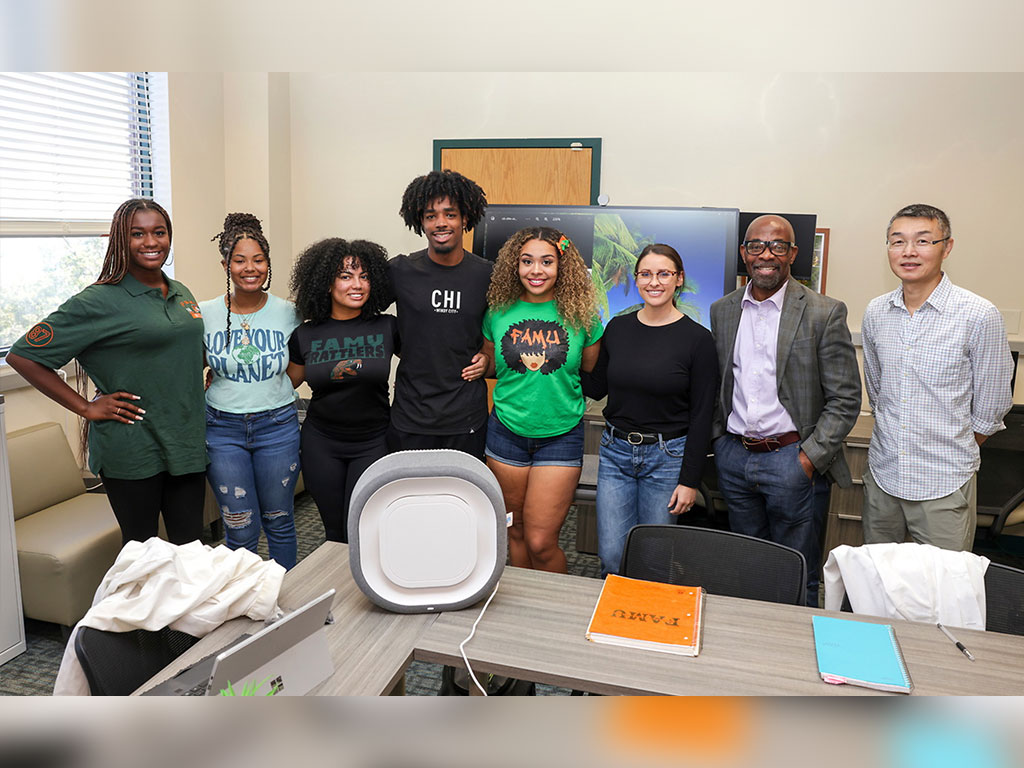 Students and faculty in Florida A&M University's School of the Environment gather
around one of the Center of Excellence for Indoor Air Quality's environmental monitoring
sensors. Through hands-on research, artificial intelligence and real-time data analysis,
the School prepares students to address challenges related to hurricane preparedness,
climate resilience and public health. (Photo courtesy of Florida A&M University.)
Students and faculty in Florida A&M University's School of the Environment gather
around one of the Center of Excellence for Indoor Air Quality's environmental monitoring
sensors. Through hands-on research, artificial intelligence and real-time data analysis,
the School prepares students to address challenges related to hurricane preparedness,
climate resilience and public health. (Photo courtesy of Florida A&M University.)
Media Contact:
Ashley Flete
Senior Communications Specialist
ashley1.flete@famu.edu