
Guarding the Hive: FAMU Researchers Develop Sustainable Solutions to Protect Honeybees from Invasive Pest
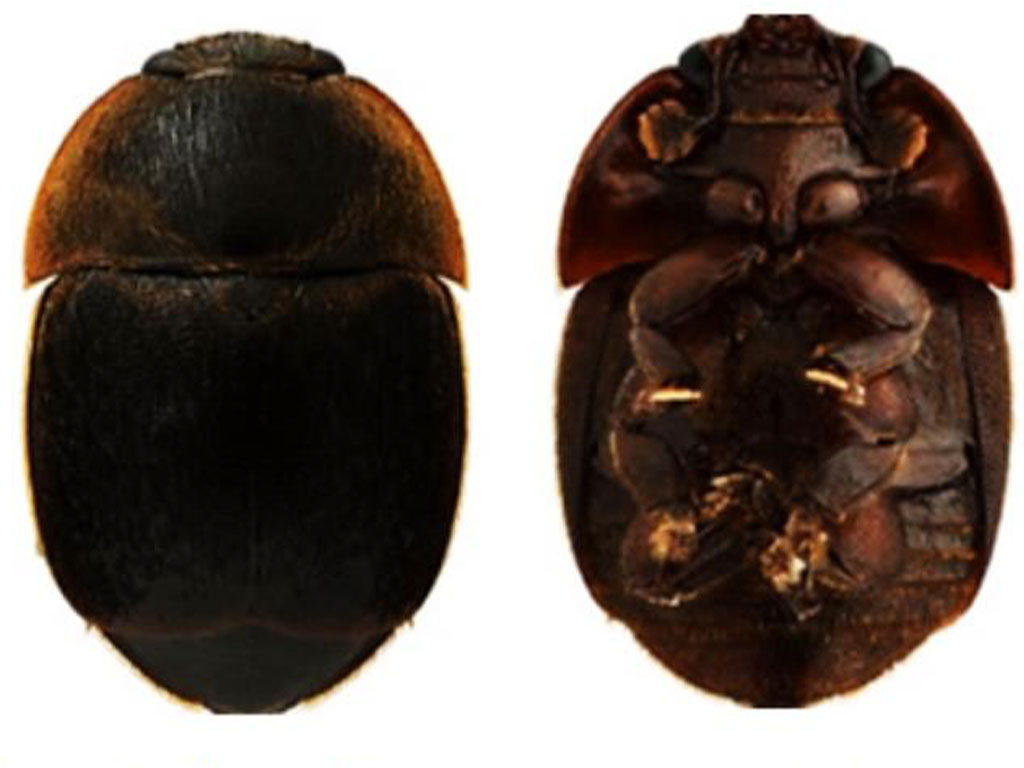
TALLAHASSEE, Fla. — Honeybees pollinate nearly one-third of the food consumed in the United States, making them one of agriculture's most valuable resources. But an invasive pest, the small hive beetle (Aethina tumida),continues to threaten colonies across Florida and beyond.
At Florida A&M University's College of Agriculture and Food Sciences, researchers are working to change that.
Through innovative research focused on sustainable pest management, scientists in FAMU's entomology program are developing new strategies to help beekeepers protect honeybee colonies while reducing reliance on traditional chemical treatments. Their work could improve colony health, strengthen agricultural production and support one of Florida's most important industries.
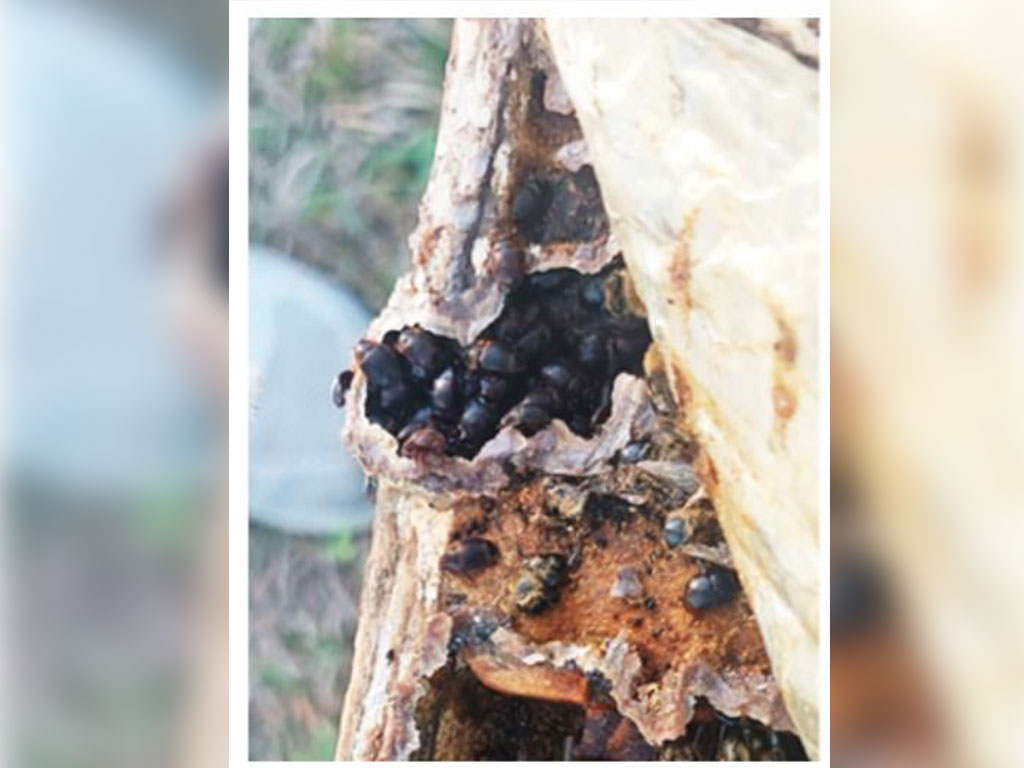 Small hive beetles infest a honey bee colony, where they feed on pollen, brood and
honey, weakening hives and threatening colony health. Researchers at Florida A&M University's
College of Agriculture and Food Sciences are studying sustainable pest management
strategies to help beekeepers protect honey bees from the invasive pest. (Photo courtesy
of FAMU College of Agriculture and Food Sciences)
Small hive beetles infest a honey bee colony, where they feed on pollen, brood and
honey, weakening hives and threatening colony health. Researchers at Florida A&M University's
College of Agriculture and Food Sciences are studying sustainable pest management
strategies to help beekeepers protect honey bees from the invasive pest. (Photo courtesy
of FAMU College of Agriculture and Food Sciences)
Leading the effort is Professor of Entomology Lambert H. B. Kanga, Ph.D., whose research includes biologically-based integrated pest management strategies for the small hive beetle. He said that “the small hive beetle has become a growing concern for beekeepers throughout the United States as this invasive pest has developed resistance to insecticides”
Once inside a hive, small hive beetles reproduce rapidly, feeding on pollen, honey and developing bee brood. As infestations grow, they contaminate honey stores, cause honey to ferment and weaken colonies, sometimes resulting in complete hive collapse and significant financial losses for beekeepers.
"Our goal is to identify safer, more sustainable ways to manage small hive beetles
while protecting honeybee colonies," said Anamika Sharma, Ph.D., Associate Professor of Entomology in Dr. Kanga's team. "Healthy honeybees are essential because they are responsible for pollinating
many of the crops people rely on every day."
Honeybees are among the world's most important pollinators, supporting the production of fruits, vegetables, nuts and countless other agricultural commodities. In Florida, where agriculture contributes billions of dollars to the state's economy, maintaininghealthy bee populations is critical to food production and environmental sustainability.
Graduate student Monique Farquharson has spent nearly two years working under the guidance of Dr. Kanga to identify more environmentally responsible methods of controlling the destructive pest.
 Monique Farquharson, a graduate research assistant in Florida A&M University's College
of Agriculture and Food Sciences, is studying honeybee health and developing strategies
to combat invasive pests that impact pollinator populations. (Photo courtesy Monique
Farquharson)
Monique Farquharson, a graduate research assistant in Florida A&M University's College
of Agriculture and Food Sciences, is studying honeybee health and developing strategies
to combat invasive pests that impact pollinator populations. (Photo courtesy Monique
Farquharson)
"My research focused on assessing biologically based integrated pest management strategies for the small hive beetle," she said. "This research aimed to explore alternative control options to incorporate into a broader pest management program."
According to Farquharson, the invasive beetle has contributed to an estimated $3 million in losses for Florida beekeepers since it was first introduced into the state, making the search for more effective management strategies increasingly important.
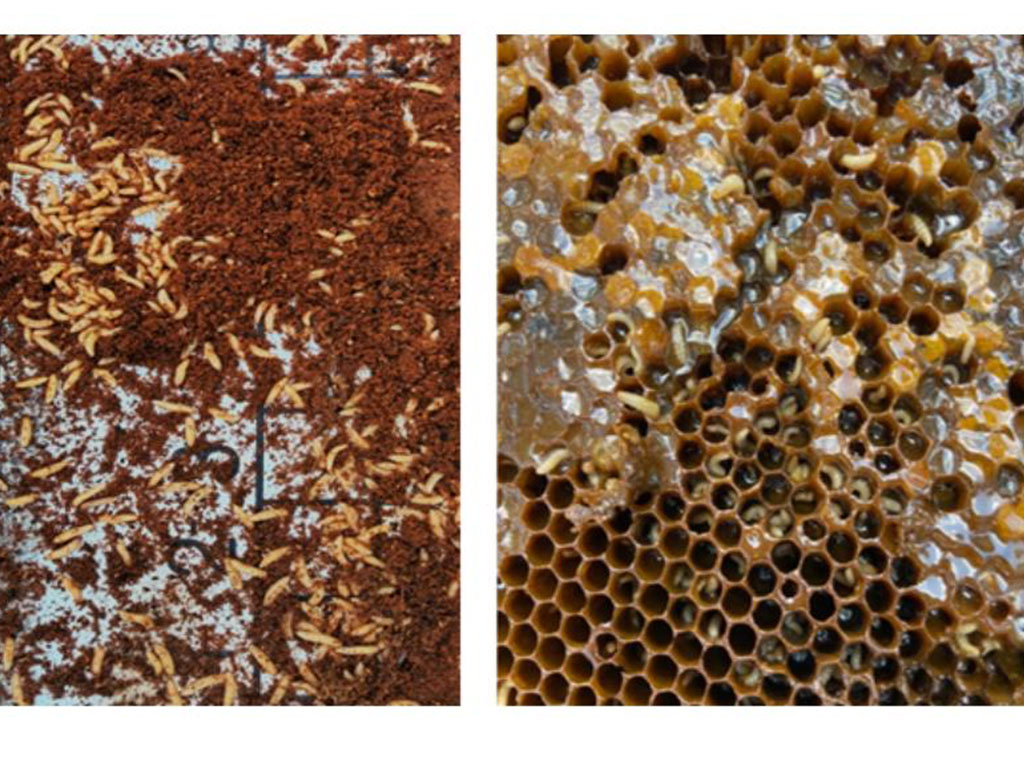 Honeybee brood comb affected by small hive beetles shows larvae feeding throughout
the hive. The invasive pest can damage honeycomb, consume stored honey and pollen,
and contribute to colony decline. (Photo courtesy of FAMU College of Agriculture and
Food Sciences.)
Honeybee brood comb affected by small hive beetles shows larvae feeding throughout
the hive. The invasive pest can damage honeycomb, consume stored honey and pollen,
and contribute to colony decline. (Photo courtesy of FAMU College of Agriculture and
Food Sciences.)
Her work examines several biological and chemical control methods, including entomopathogenic fungi, insect growth regulators and select insecticides to determine which approaches can be incorporated into long-term integrated pest management programs.
The team's findings have identified promising results.
Researchers discovered that additional entomopathogenic fungi as potential biological control agents while also identifying signs that some beetle populations have developed resistance to new generation insecticides.
One finding showed younger beetle larvae proved significantly more susceptible to insect growth regulators than older larvae, suggesting that the timing of treatments may play a critical role in improving pest control.
"In honeybee colonies, there are specific things that are responsible for crashing down colony performance, such as diseases and other insects," Sharma said. "If people know what pesticides can help manage these hive beetles that are so problematic for honeybees, it is going to help local beekeepers. Better honeybee colony health means more honey production and more pollination happening."
The need for new solutions has become increasingly important as some commonly used insecticides, including coumaphos, , have become less effective because certain beetle populations have developed resistance over time.
Beyond advancing scientific knowledge, the research is also preparing the next generation of agricultural scientists.
"FAMU offers many opportunities for research like this from undergraduate to master's to Ph.D.," Sharma said. "Students can even shadow master's or Ph.D. researchers to gain hands-on experience and strengthen their learning."
In addition, our Program offers financial opportunities to support BS, MS and PhD students” Dr. Kanga said.
For Farquharson, those opportunities have extended far beyond the laboratory, strengthening her laboratory, analytical and scientific research skills while preparing her for doctoral studies in veterinary entomology. More importantly, she said, it has given her the opportunity to contribute to research that could have a lasting impact on agriculture and beekeeping.
Media Contact:
Ashley Flete
Senior Communications Specialist
ashley1.flete@famu.edu