
Insects as Evidence: FAMU Researchers Use Forensic Entomology to Strengthen Criminal Investigations
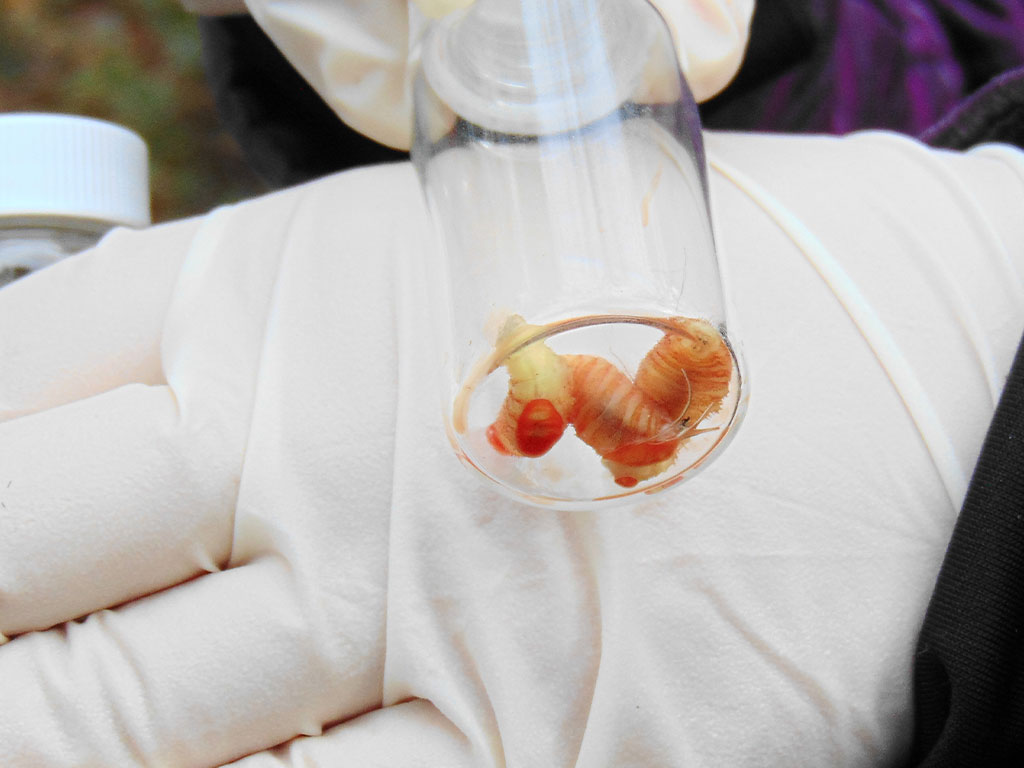
TALLAHASSEE, Fla. — When investigators arrive at a crime scene, some of the most valuable witnesses aren't people,they're insects. At Florida A&M University's College of Agriculture and Food Sciences, researchers are studying how insects colonize decomposing remains to help forensic investigators estimate time of death and strengthen criminal investigations across Florida.
Forensic entomology, the study of insects as they relate to criminal investigations, plays an important role in reconstructing the events surrounding a death. By identifying the types of insects present, understanding when they arrive and studying their life cycles, scientists can provide critical information that supports death investigations and helps law enforcement establish a more accurate timeline of events.
At FAMU, Lee Bushong, PhD., associate Professor of Forensics and Criminal Justice, and Anamika Sharma, Ph.D., assistant professor of entomology, and are leading research that focuses on insect activity during decomposition. Her work aims to expand Florida-specific forensic data while providing students with hands-on research experiences that connect classroom learning with real-world scientific investigations.
"Our goal is to better understand what insects are attracted to decomposing remains and how quickly they arrive," Sharma said. "That information can help investigators estimate the time since death and provide valuable evidence during an investigation."
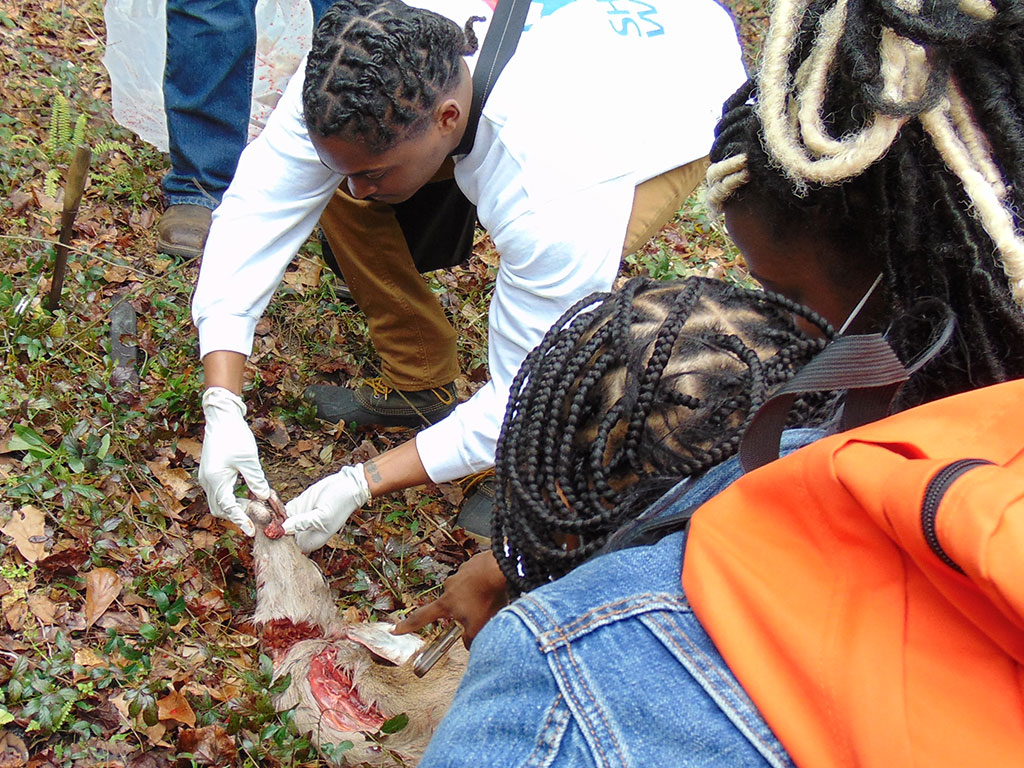 Students participate in a forensic entomology field exercise that provides practical
training in evidence collection and the scientific methods used to estimate postmortem
intervals in forensic investigations. (Photo courtesy of FAMU College of Agriculture
and Food Sciences.)
Students participate in a forensic entomology field exercise that provides practical
training in evidence collection and the scientific methods used to estimate postmortem
intervals in forensic investigations. (Photo courtesy of FAMU College of Agriculture
and Food Sciences.)
To better understand decomposition under Florida's environmental conditions, Sharma and her research team use animal models that closely resemble natural decomposition processes.
“We collect a dead deer carcass, and study the insects on the dead body,” Sharma said.
“We research what type of insects the carcass is attracting, at what rate and in which sequence.”
As decomposition progresses, different insect species arrive in a predictable sequence. Blow flies, flesh flies, beetles, and ants each appear at different stages, providing investigators with valuable clues about how long remains have been exposed and the conditions surrounding a death.
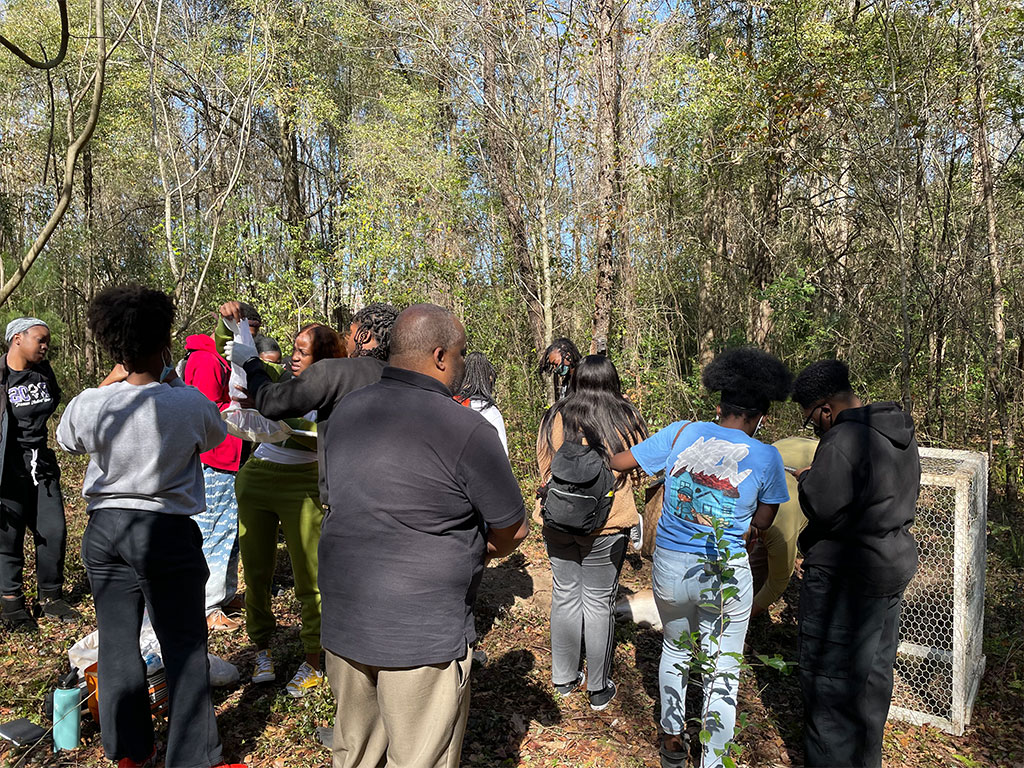 Students participate in a hands-on forensic entomology field exercise, learning how
insects are collected and analyzed to help estimate postmortem intervals and assist
in criminal investigations. The experiential training provides students with real-world
skills used in forensic science. (Photo courtesy of FAMU College of Agriculture and
Food Sciences.)
Students participate in a hands-on forensic entomology field exercise, learning how
insects are collected and analyzed to help estimate postmortem intervals and assist
in criminal investigations. The experiential training provides students with real-world
skills used in forensic science. (Photo courtesy of FAMU College of Agriculture and
Food Sciences.)
The research is especially significant because relatively little forensic entomology data exists for North Florida.
“In North Florida, we do not have a lot of data historically available, so any data that we collect
here is going to help our law enforcement and police departments,” Bushong said.
Florida's warm, humid climate presents unique challenges for forensic investigations. Heat and moisture accelerate decomposition, making it essential for researchers to understand how local environmental conditions influence insect activity and development.
"Florida's climate is very warm and humid, and insects love this kind of environment, so anything that is decomposing in this climate will decompose much faster," Sharma said.
Beyond estimating time since death, the research has broader forensic applications. Sharma's team is documenting fly species found throughout Florida to help investigators determine whether human remains may have been moved from another location.
"We are right now collecting the different species of flies in Florida, so if somebody were to move a dead body from another state and it had a specific species on it, we would be able to tell that the body has been moved," Sharma said.
The project is also preparing the next generation of forensic scientists by providing undergraduate and graduate students with hands-on research opportunities.
"I teach a class along with Bushong for undergraduate students at FAMU where they also examine dead carcasses and research the insects around the body, so they get hands-on experience early," Sharma said.
For Maya Mancle, who recently earned her master's degree in entomology with a concentration in forensic entomology, participating in the research provided an opportunity to combine two longtime interests: criminal justice and science.
"My academic background combines criminal justice and entomology because I've always been interested in applying science to criminal investigations," Mancle said.
Throughout the project, Mancle monitored insect activity during decomposition, documenting which species arrived, when they appeared and how environmental conditions influenced their development.
"We monitor the decomposition process and document which insect species arrive, when they arrive and how environmental conditions affect their development," Mancle said. "Animal carcasses serve as an excellent model because they closely mimic many of the biological processes that occur during human decomposition."
She said insects are often among the first organisms to arrive after death, making them valuable indicators during forensic investigations.
"Insects are often some of the first organisms to arrive after death," Mancle said. "By identifying these insects and understanding their life cycles, researchers can estimate how long a body has been decomposing and sometimes gain insight into environmental conditions surrounding the death."
Mancle emphasized that building a Florida-specific forensic database is critical because insect behavior differs across climates and geographic regions.
"Florida's warm temperatures, high humidity and diverse insect populations create decomposition patterns that differ from other regions of the country," she said. "Because insect development is heavily influenced by temperature and climate, it's important to collect region-specific data."
Their findings have also uncovered that decomposition is influenced not only by time but also by the environment in which it occurs.
"Small changes in weather, temperature, or habitat can influence insect activity and decomposition," Mancle said.
As the project continues, researchers hope their work will strengthen forensic databases and advance the scientific tools available to investigators.
"The findings can improve the accuracy of death investigations, helping investigators provide more reliable information to families and the justice system," Mancle said.
As forensic science continues to evolve, the work taking place at Florida A&M University is helping build a scientific foundation to solve cases with greater accuracy. At the same time, it is preparing the next generation of forensic scientists through hands-on learning experiences that bridge classroom instruction with real-world investigations.
Media Contact:
Ashley Flete
Senior Communications Specialist
ashley1.flete@famu.edu